

Published: 30 October 2026
Before reading any further, try something. Open a private browser window, or hand your phone to someone who doesn't already know your business, and search for the service you offer plus your city — the exact way a stranger looking for what you sell would search. Now look honestly at what shows up.
Is your business there? On the map, in the top results, with recent reviews and accurate details? Or is the first page filled with other names — competitors, directories, or businesses you've never even heard of?
This single test tells you more about your real-world competitiveness than almost any other exercise, because it replicates exactly what a genuine prospective customer experiences the moment they decide they need what you offer.
It's worth repeating this test for more than one search phrase. Customers rarely search using your exact business category — they search the way they naturally think and speak, which can be surprisingly different from how you'd describe your own business. A furniture shop owner might think of themselves as a "modular furniture retailer," while a customer simply types "sofa shop near me." If you only ever check the phrase you'd use yourself, you may be missing the actual searches driving real enquiries.

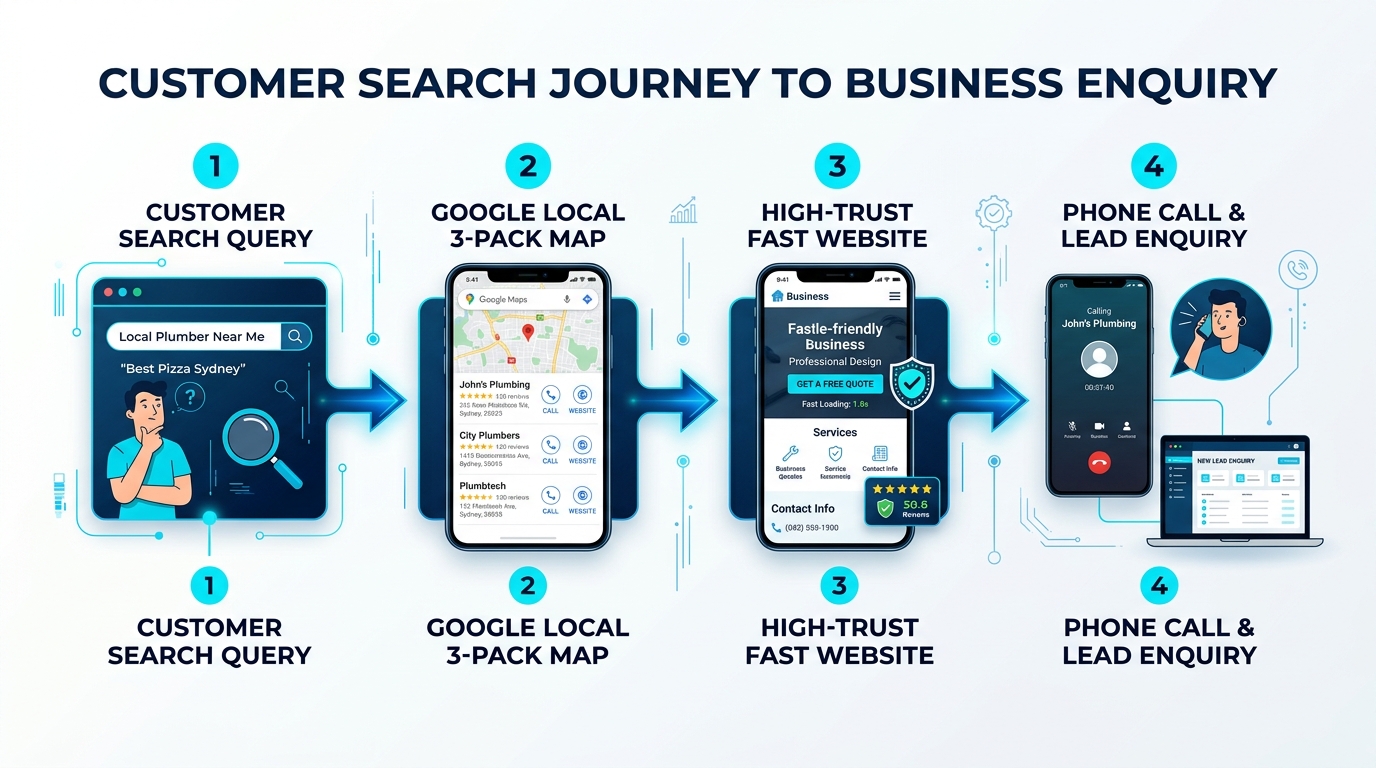
Search has quietly become the default starting point for most purchase decisions, from choosing a plumber to picking a clinic or comparing furniture shops. The businesses that appear at that moment get considered. The ones that don't, generally aren't — not because they're worse, but because they were simply never part of the comparison.
What makes this especially consequential is that the customer rarely questions whether the results are "fair." They assume, reasonably, that whoever shows up near the top is credible, active and relevant, and whoever doesn't show up either doesn't exist or isn't worth considering. Your actual quality of work plays no part in that first impression — visibility does.
There's another layer worth noting: this search happens at the exact moment of highest intent. Someone searching "emergency plumber near me" or "pediatrician Thrissur" isn't casually browsing — they have a specific need, right now, and are actively deciding who to call. Missing this particular moment is far costlier than missing a casual social media scroll, because the searcher is actively ready to spend money and choose someone within minutes.
Without clear categories, services and a filled-in description, Google has little to match your business against a search.
If your pages don't clearly describe the services people are searching for, in their own words, there's nothing for Google to match.
Technical issues — slow loading, broken mobile layout, missing page titles — quietly work against you even if the content is fine.
A handful of old reviews, or none at all, signals low activity compared to a competitor with a steady, recent flow.
Directories, local press, partner websites and citations all add small signals of trust that, together, make a real difference.

What makes these mistakes particularly easy to miss is that they're invisible from the inside. If you already know your business exists and what it offers, it's hard to appreciate how a stranger experiences searching for your services with none of that prior knowledge. That's exactly why the search test described above is worth doing honestly, on a device and account that has no history with your business.

It helps to demystify this a little. Google isn't trying to pick favourites — it's trying to answer the searcher's question as accurately and reliably as possible. For local searches, it generally weighs three broad factors: how relevant your business is to what was searched, how close you are to the searcher (for location-based queries), and how prominent or trustworthy your business appears based on reviews, links, and overall online presence.
None of these factors is about having the flashiest website. A modest, well-structured site with clear service pages, consistent information and genuine customer reviews regularly outperforms a visually impressive site that neglects these basics. This is good news: competing on visibility is less about budget and more about doing the fundamentals properly and consistently.
You can see this play out across Thrissur's own business landscape — compare how differently established and newer companies present themselves in our Thrissur IT companies directory and the broader Thrissur companies list.
It's also worth understanding that search results aren't static. A business that ranks well today can slip if a competitor becomes more active, or if the website develops technical issues that go unnoticed. Equally, a business with no visibility today isn't stuck there permanently — consistent, honest effort on the fundamentals tends to move the needle over a realistic timeframe, even in competitive categories.
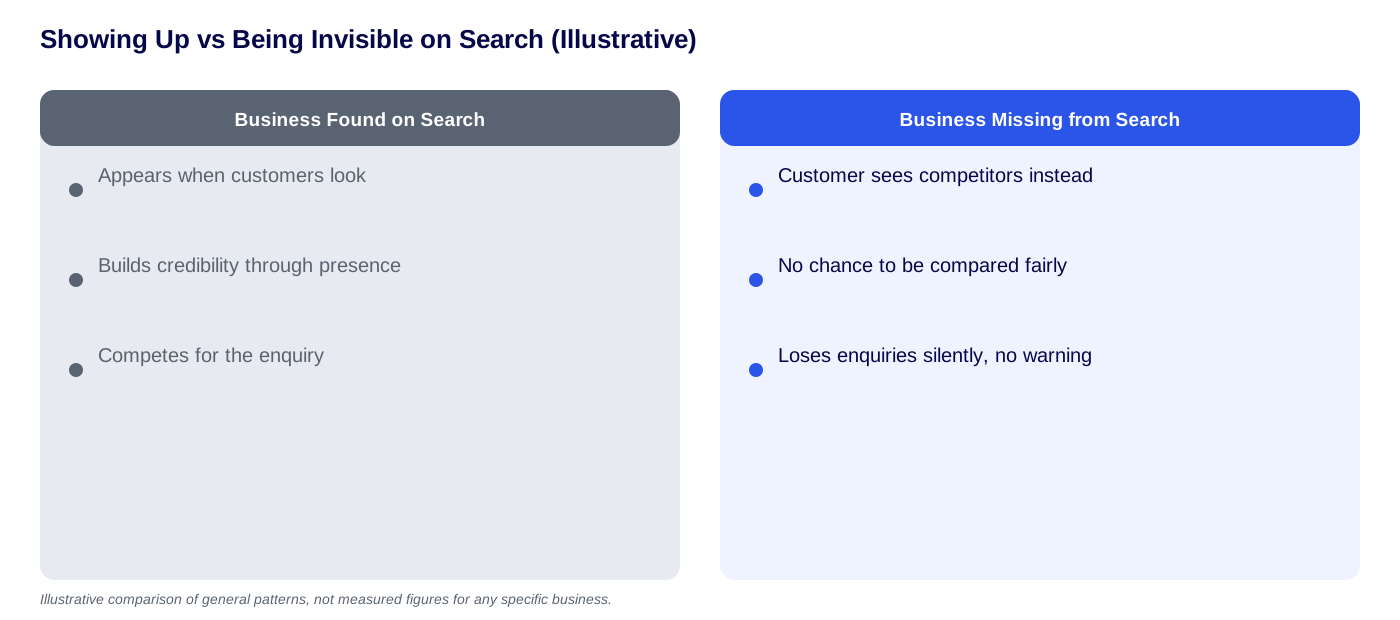
Consider two home renovation contractors operating in the same part of Kerala, offering comparable quality of work. Contractor A relies on referrals and has never updated an online profile. Contractor B maintains a simple, accurate Google Business Profile, has a basic website describing specific services like kitchen remodelling and flooring, and responds to the occasional review.
When a homeowner new to the area searches "kitchen renovation contractor" plus their locality, Contractor B appears with a map listing, photos of past work, and a handful of reviews. Contractor A doesn't appear at all for that search, despite potentially being the more experienced of the two. The homeowner, having no other basis for comparison, contacts Contractor B simply because they were the one visible at the moment of decision.
This scenario illustrates a common pattern we observe across service businesses; it does not describe an actual documented client result.
One habit worth building early is keeping a simple log of what you tried and what changed afterwards — which pages you updated, which listings you completed, and whether rankings or enquiries shifted in the weeks after. SEO can feel abstract without this kind of record, and having it makes it far easier to tell genuine progress apart from normal week-to-week fluctuation.
SEO is one of those services where promises can run well ahead of what's realistically deliverable, especially from vendors offering guaranteed "#1 rankings" at suspiciously low prices. Treat any such guarantee with caution — no legitimate provider can promise a specific ranking position, since search engines control that outcome, not the agency.
If you're evaluating who to work with on this, our guide on choosing the right IT company without falling into the cheap-pricing trap covers exactly the kind of questions worth asking before signing anything.
It also helps to separate what you can reasonably do yourself from what genuinely benefits from experience. Claiming and completing your Google Business Profile, writing honest service descriptions, and asking happy customers for reviews are all well within reach for most business owners. Technical SEO — site structure, page speed, schema markup, content strategy across competitive terms — is where experienced help tends to make a measurable difference, simply because the learning curve is steep and mistakes here can be hard to diagnose without specialised tools.
Your website should do more than simply exist online. It should build trust, attract the right audience and support your business goals.
We'll walk through your current search visibility honestly, and outline what's realistically achievable before you spend a rupee.
Discuss Your ProjectOpen an incognito or private browser window, or use a phone that isn't signed into your business accounts, and search the way a real customer would: your service plus your city. Note whether you appear in the map pack, the organic results, or neither.
Paid ads occupy a separate section of the results page and can be a valid short-term tactic, but they stop working the moment you stop paying. Appearing in organic results and the map pack through SEO tends to be more durable, and the two can also work well together.
No. It's usually far more valuable to rank well for the handful of searches your real customers actually use than to chase a long list of broad or unrealistic keywords with little commercial value for your business.
Ranking for your own name is relatively easy since there's little competition for it. Ranking for a generic service term means competing against every other business offering the same thing, which requires stronger on-page SEO, content and local signals.
Local SEO focuses specifically on signals like your Google Business Profile, local citations, proximity and reviews, which matter most for businesses serving a specific city or region. Regular SEO covers broader on-page and content factors that matter regardless of location.
This depends heavily on your starting point, competition and the specific terms involved, so we avoid quoting a fixed timeframe without reviewing your situation first. Some local fixes can show change within weeks; broader competitive terms usually take longer.