

Published: 30 October 2026
Most business owners choose a web development company the way they'd choose a restaurant for a one-off dinner: a quick look at reviews, a gut feeling, maybe a referral from a friend. The problem is that hiring a web development company is closer to hiring a contractor to build an extension on your house — the relationship lasts well beyond the handover, and getting it wrong is expensive to undo.
Unlike a one-off dinner, a web development project typically involves weeks or months of back-and-forth, access to sensitive business information, and a finished product your customers will judge you by for years. A mismatch discovered early — in the first week of conversations — costs you nothing but a little time. The same mismatch discovered after a deposit is paid and work has begun can cost significant money, delay and frustration to unwind.
A structured checklist won't guarantee a perfect outcome, but it dramatically reduces the chance of an avoidable, costly mistake. Below are ten things worth actually checking — not just asking about casually, but verifying — before you sign anything.
Each point below is written as something you can genuinely verify, not just ask about politely and accept whatever answer comes back. There's a meaningful difference between a company telling you "we handle support well" and a company showing you their actual support process, response-time commitments, and a reference you can call to confirm it. Treat every item here the same way — as something to confirm, not merely discuss.
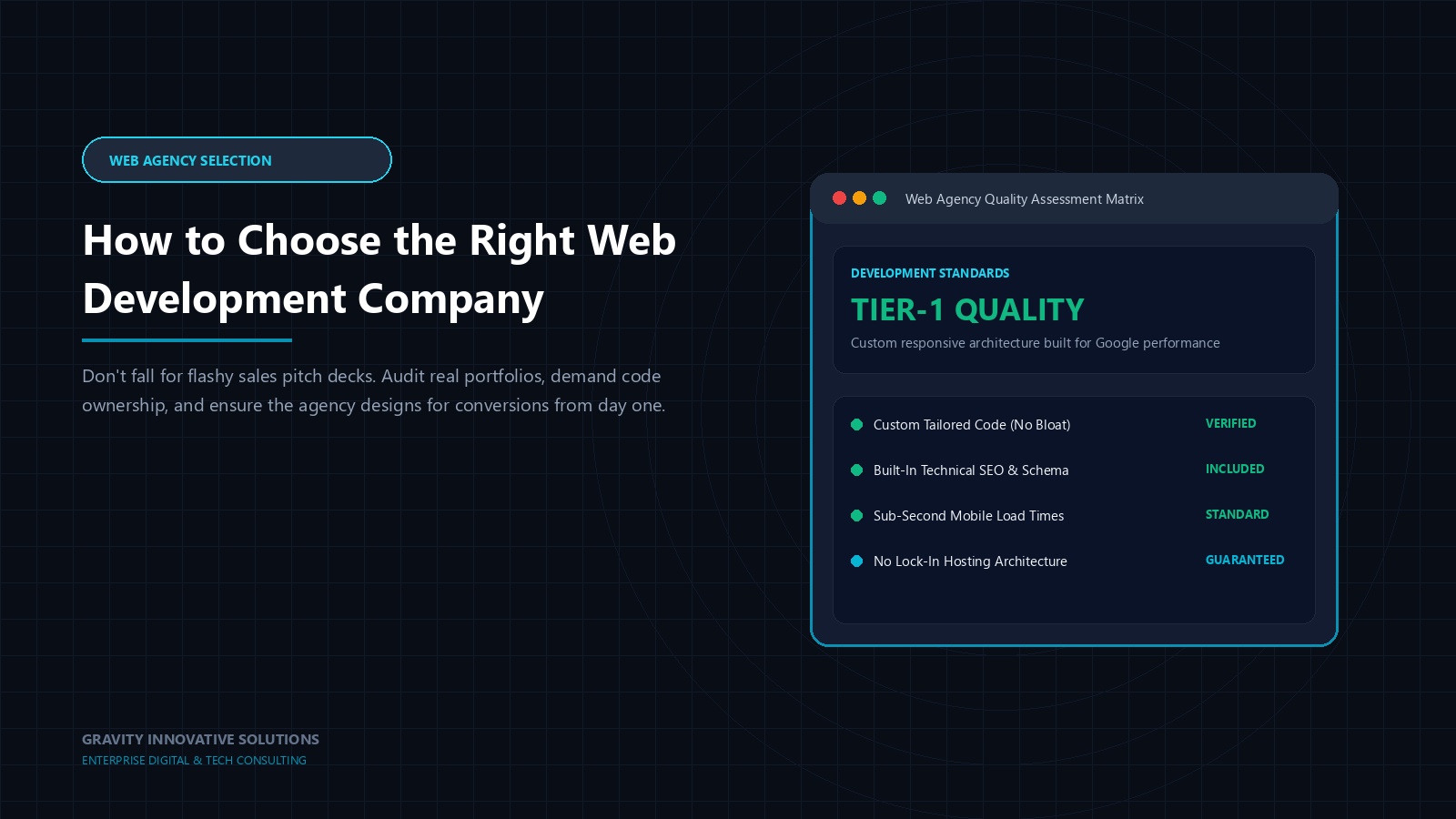
Consider a small logistics company that hired a web developer purely based on a friend's casual recommendation, without asking any of the questions below. Midway through the project, it became unclear who actually owned the website's code, the developer became hard to reach for weeks at a time, and the final site, when delivered, had no mobile-friendly layout at all — a basic requirement that was never discussed upfront.
None of this was due to bad intent necessarily; it happened because expectations were never clarified in writing before work began. A short, structured checklist conversation at the start would likely have surfaced every one of these issues before any money changed hands.
This scenario illustrates a pattern we commonly see; it is not a documented case from a specific client.
Ask to see live, working examples — not just screenshots — ideally in a similar industry or of similar complexity to your project. A company that has built retail ecommerce stores will generally serve a new retailer better than one whose portfolio is all brochure websites.
Confirm they have real experience with the specific technology your project requires — a CMS, custom application, ecommerce platform or mobile integration — rather than a generic "we can build anything" answer. A company that genuinely knows a technology can usually explain, in plain language, why it fits your project and what its limitations are; a company that doesn't will tend to stay vague or steer the conversation back to generalities.
Ask directly who will do the work. In-house teams generally offer better accountability, faster revisions and more consistent quality control than heavily subcontracted arrangements. This isn't to say subcontracting is always a problem — some excellent specialists work this way deliberately — but you deserve to know upfront so you can judge communication and oversight accordingly.
A detailed, itemised quote tied to specific deliverables is far more trustworthy than a vague "starting from" figure. See our general pricing guide for the factors that typically shape a quote — again, a guide to the conversation, not a quoted rate.
Ask who your day-to-day point of contact will be, what tools they use to track progress, and how often you can expect updates. Vague answers here often predict a frustrating project — not necessarily because the work itself will be poor, but because you'll struggle to know what's happening, when, and why, which erodes trust even on a project that's technically on track.
Confirm exactly what happens after launch: bug fixes, response times, and whether ongoing maintenance is included or billed separately. A website needs upkeep; know what that costs and covers before you need it urgently.
A site built without basic SEO foundations — clean URLs, proper headings, fast load times, mobile responsiveness — can be invisible to search engines no matter how good it looks. Ask how this is handled by default, not as a paid add-on you have to request.
Ask for two or three references you can call or message directly, not just testimonials published on the company's own website. A company confident in its work should have no hesitation here.
Make sure the agreement states, in writing, that you own the final code, design and content once paid for, along with scope, timeline, revision limits and payment milestones. Without this in writing, disputes over who owns the finished website can become surprisingly difficult to resolve, especially if the relationship with the developer later turns sour.
Check how long the company has been operating and whether their way of working, communication style and pricing structure genuinely fit your business, not just their sales pitch. Our about page is an example of the kind of background information worth checking for any vendor you're seriously considering. A company that has operated in the same market for many years has typically survived by handling disputes, changing technology and difficult clients reasonably well — that staying power is itself a useful, if imperfect, signal.

Check how long the company has been operating and whether their way of working, communication style and pricing structure genuinely fit your business, not just their sales pitch. Our about page is an example of the kind of background information worth checking for any vendor you're seriously considering. A company that has operated in the same market for many years has typically survived by handling disputes, changing technology and difficult clients reasonably well — that staying power is itself a useful, if imperfect, signal.

Print or copy this list before your first call with any shortlisted company. Ask each point as a direct question and note how confidently and specifically they answer — vague, deflecting answers are often more revealing than the answer itself. Use the same ten questions across every company you're comparing, so you're judging them on equal footing rather than being swayed by whoever presents best.
It also helps to space these conversations out rather than rushing through all your shortlisted calls in a single afternoon. Fatigue sets in quickly when comparing similar pitches back to back, and the details that matter most — a hesitant answer on ownership, a confident but unverifiable promise on timeline — are easier to notice with a clear head. Take notes immediately after each call while the specifics are still fresh, rather than relying on memory once you've spoken to three or four companies.
Finally, trust your own discomfort. If a particular answer leaves you uneasy, that's worth probing further rather than explaining away, even if everything else about the company looks professional on the surface. The businesses that end up with the smoothest projects are rarely the ones that picked the most polished pitch — they're the ones that asked the uncomfortable questions early and acted on what they heard.
If your project involves a mobile component alongside the website, our page on mobile app development covers a few additional considerations specific to that kind of build. And if pricing promises in particular are worrying you, our companion guide on avoiding the cheap-pricing trap goes deeper into that specific risk.
One last thing worth saying plainly: no company, including ours, will score a perfect ten on every single point for every single business. The goal of this checklist isn't to find flawless marks — it's to go into the decision with your eyes open, aware of exactly what you're trading off, rather than discovering the gaps only after you've already committed.
Your website should do more than simply exist online. It should build trust, attract the right audience and support your business goals.
We're glad to answer every one of these ten questions directly and in writing — ask us anything before you decide.
Discuss Your ProjectEven for a small project, the fundamentals — portfolio relevance, transparent pricing, support terms and contract clarity — are worth checking. You can be lighter on points like team structure if the project is genuinely small, but skipping due diligence entirely raises your risk unnecessarily.
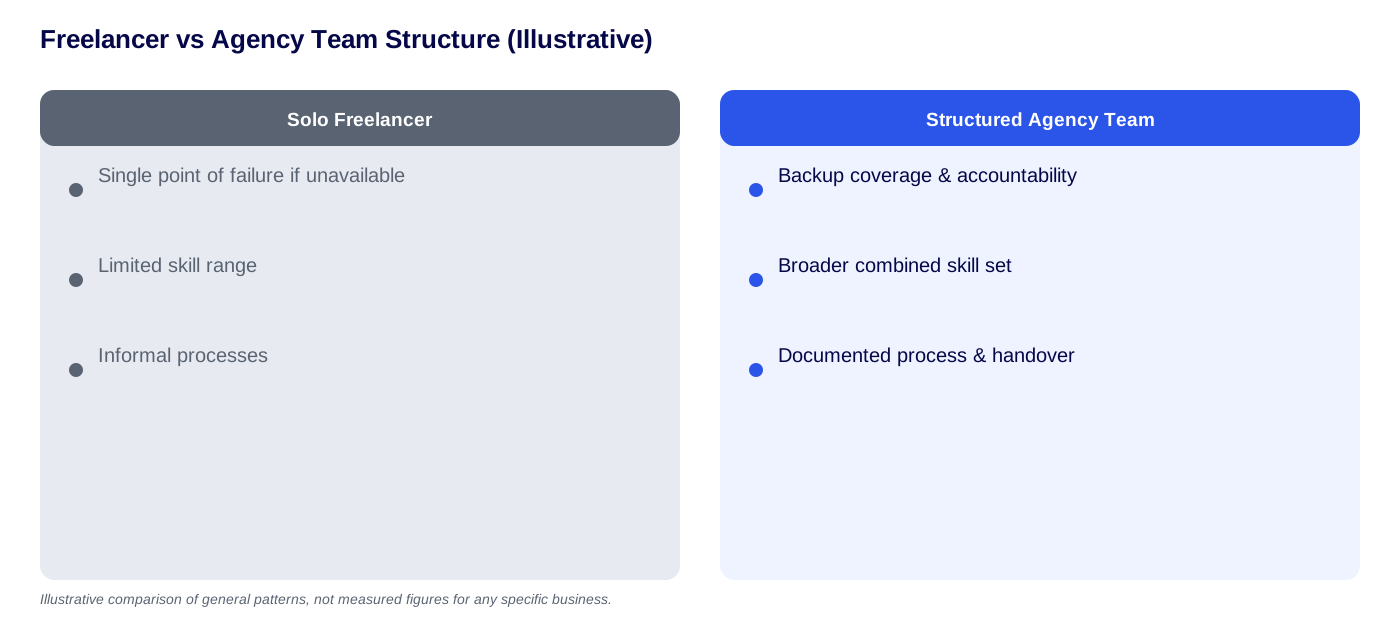
Both can work well depending on project size and complexity. Freelancers can suit small, simple projects at lower cost; agencies generally offer more accountability, broader skills and continuity if a single person becomes unavailable. Match the choice to your project's risk and complexity.
Transparent, scope-based pricing and a written contract tend to prevent the most common disputes. Without clarity there, almost every other issue — scope creep, missed deadlines, unclear ownership — becomes harder to resolve fairly.
Three to five is usually a practical range — enough to compare meaningfully without the process dragging on for weeks. Beyond that, decision fatigue tends to set in without much extra benefit.
Yes, and it's a good sign. A company that quotes without understanding your goals, audience or existing setup is more likely to deliver something generic or mismatched to what you actually need.
Weigh the failed points by how much risk they actually carry for your project. A missing SEO-readiness habit might be fixable with a clear conversation; a reluctance to put anything in writing is a more fundamental concern worth taking seriously.