

Published: 30 October 2026
Most businesses don't notice their technology setup is holding them back until something forces the issue — a system crashes during a busy period, a manual process that used to take an hour now takes half a day because the business has grown, or a competitor launches something your current setup simply can't support.
Technology, done well, is meant to fade into the background — you notice it only when it fails you. That makes it genuinely difficult to appreciate its value in the abstract, which is part of why so many businesses underinvest in getting this relationship right until a painful moment forces a reassessment.
Until that point, "good enough" technology tends to stay invisible. Nobody budgets for the quiet cost of a slow website, a support provider who only responds after something breaks, or a patchwork of tools that don't talk to each other. These costs don't show up as a single line item — they show up as wasted hours, frustrated staff, and growth that takes longer and costs more than it should.
This article looks honestly at how a well-matched technology partner tends to change that picture — through illustrative patterns we commonly observe, not claims about any specific client, since we don't publish case studies or figures we can't stand behind.

A small inefficiency is easy to absorb when a business is small — a manual workaround costs a few extra minutes, a clunky system is annoying but survivable. As a business grows, those same small frictions multiply. The manual workaround now eats up a staff member's whole afternoon every week. The clunky system becomes the reason a new product launch takes twice as long as planned.
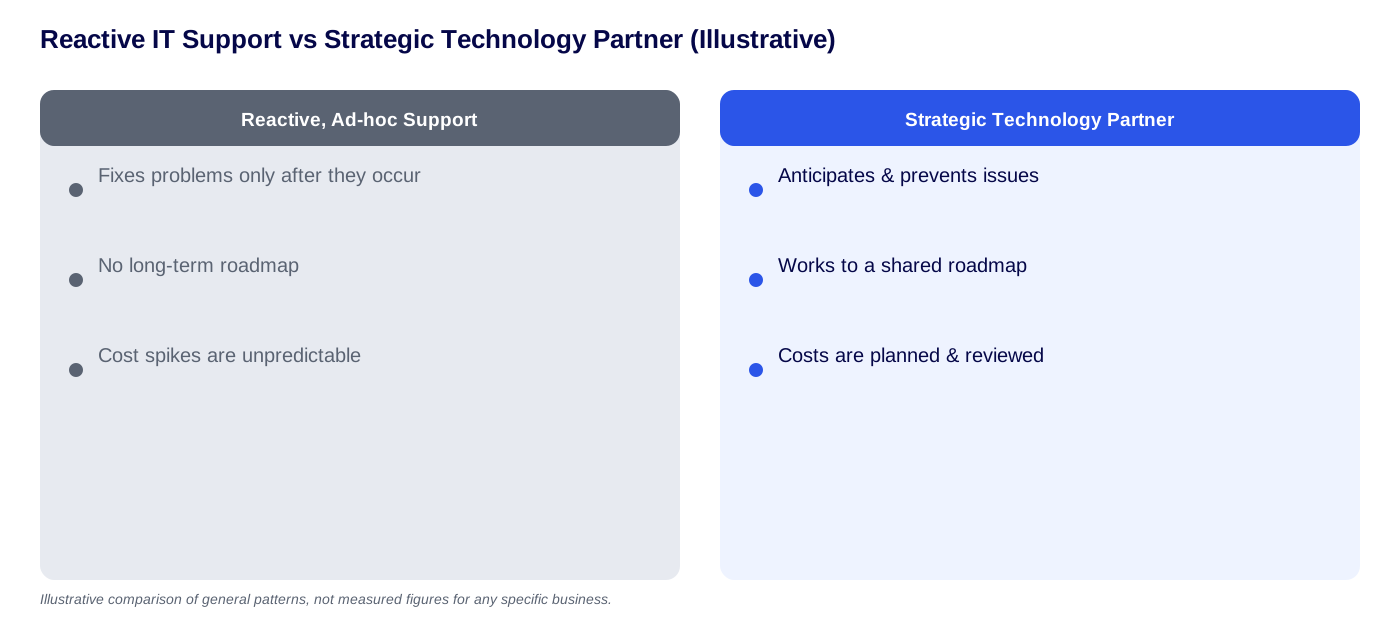
This is why the choice of technology partner tends to matter more, not less, as a business scales. A partner who only ever reacts to problems as they occur can keep a small operation limping along; a partner who actively helps you anticipate and plan for growth tends to prevent many of these frictions from accumulating in the first place.
There's a budgeting angle here too, often overlooked. Reactive technology spend tends to arrive unpredictably — an emergency fix, a sudden outage, a rushed rebuild — which makes it hard to plan for financially. A more strategic relationship tends to convert some of that unpredictable spend into planned, reviewed investment, which is easier for any business to manage, regardless of size.
Fixing things only when they break, with no plan for what's likely to break next as the business grows.
Each tool solves one problem in isolation, but none of them share data, creating duplicate manual work to keep everything in sync.
A support relationship with long response times quietly costs far more in lost productivity than the support fee itself ever suggests.
A system that fit a five-person team rarely still fits once the business has grown to twenty, without deliberate review and adjustment.

What ties these mistakes together is a lack of regular, honest review. Few businesses set aside time to ask "is our current technology setup actually serving us well, or have we just gotten used to its limitations?" That question, asked periodically, is often the single most valuable habit a growing business can build around its technology decisions.

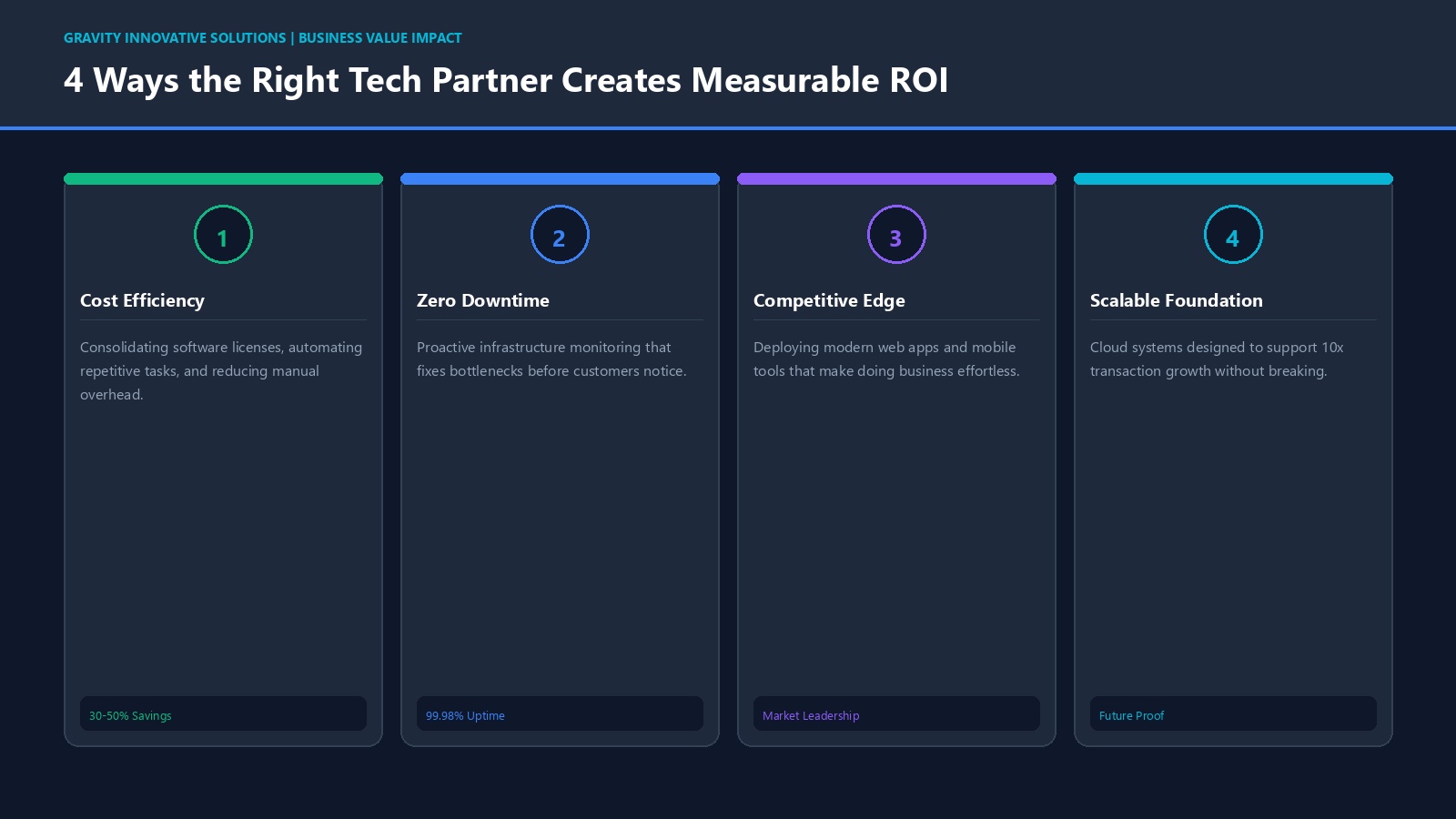
Across different industries, a few broad patterns tend to repeat themselves when a business moves from an ad-hoc technology relationship to a more strategic one:
These are general patterns we've observed across the industry, not guaranteed outcomes for any specific business — your actual results will depend on your starting point, your industry and how the engagement is managed.
It's worth being clear-eyed about sequencing, too. None of these benefits tend to appear all at once. Reliability and reduced repeat costs are usually the earliest improvements a business notices, simply because fixing recurring problems properly has an immediate effect. Smoother scaling tends to be the slowest to show, since it's really a measure of how well the business handles growth it hasn't experienced yet — which only becomes visible over time, as that growth actually happens.
Consider a growing retail chain managing inventory across three stores using separate spreadsheets, updated manually each evening by staff already stretched thin. Errors crept in regularly — a product shown as in stock online that had actually sold out in-store, leading to cancelled orders and frustrated customers.
After reviewing the setup, a more structured technology partner might consolidate inventory into a single connected system, reducing the nightly manual update to a non-issue and cutting the stock-mismatch errors significantly. The visible win isn't a dramatic new feature — it's quieter: fewer frustrated customers, fewer hours spent on manual reconciliation, and a system that can actually support a fourth or fifth store without falling apart.
This scenario illustrates a pattern commonly discussed in retail technology; it is not a documented result from a specific client engagement.
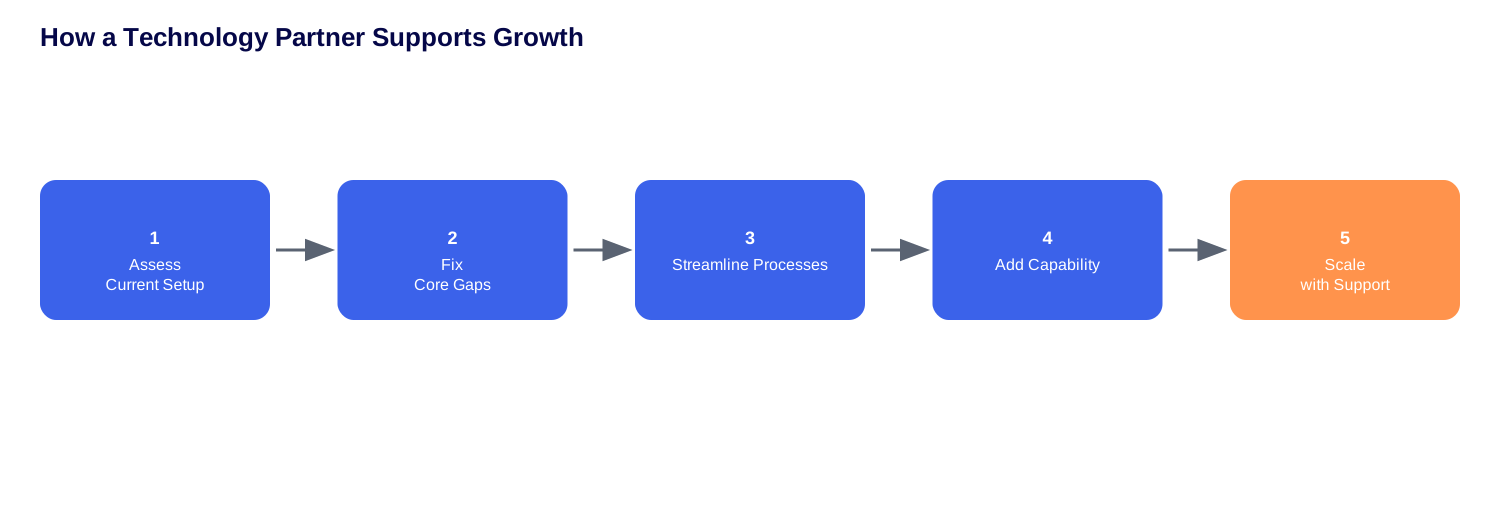
In our experience, the shift from reactive to strategic rarely happens overnight. It typically starts with an honest assessment of what's currently working and what isn't, followed by fixing the most pressing gaps, gradually streamlining processes, adding capability where it's genuinely needed, and then scaling with ongoing support rather than starting from zero each time something changes.
Patience matters here. Businesses sometimes expect a single engagement to fix everything at once, and then feel disappointed when deeper structural issues take longer to resolve than a single website bug would. Setting realistic expectations at the start — which issues can be fixed quickly, and which will take sustained work over months — tends to produce a far healthier, less frustrating relationship with any technology partner.
It's also reasonable to expect this roadmap to be revisited periodically rather than treated as fixed. A plan drawn up when a business had ten employees will likely need adjustment once it has thirty, simply because new constraints and opportunities emerge that weren't visible at the start. A good technology partner treats this roadmap as a living document, not a one-time deliverable to file away.
Not every vendor is equipped to think this way — many are set up to deliver a single project and move on, which is perfectly fine for a one-off need but less suited to an ongoing growth relationship. If you're currently evaluating who to work with, our detailed checklist on 10 things to check before choosing a web development company and our guide on avoiding the cheap-pricing trap both cover ground directly relevant here.
It's also worth understanding a prospective partner's own history and focus areas — our about page is an example of the kind of background worth checking for any vendor, and our mobile app development page shows how we think about building for growth specifically in that domain.
If you take only one idea from this article, let it be this: the value of a technology partner is rarely visible in any single deliverable. It shows up gradually, in fewer fires to put out, in systems that keep working as you grow, and in the time your team gets back to spend on the business itself rather than on managing around technology that was never quite right to begin with.
Your website should do more than simply exist online. It should build trust, attract the right audience and support your business goals.
Let's have an honest conversation about your current technology setup and where a better-fit partnership could realistically help.
Discuss Your ProjectBoth can be true depending on the engagement. The upfront cost is real, but a well-matched partner typically reduces downstream costs from rework, downtime and inefficient manual processes. Whether the net effect is a saving depends on your starting point and how the engagement is managed.
Usually it means fewer manual, repetitive tasks, faster turnaround on updates or fixes, and systems that work together instead of requiring duplicate data entry. The specific efficiency gains depend heavily on your current processes and tools.
Common signs include recurring manual workarounds, frequent downtime or bugs, slow turnaround on simple changes, and a support relationship that only reacts to problems rather than anticipating them. A technical review can clarify whether these issues are structural or easily fixable.
No. Smaller businesses often feel inefficiencies more acutely since there's less slack to absorb them. A right-fit partner scales their approach to your size rather than applying an enterprise-level process to a small team.
This varies by the scope of change involved. Simple process fixes can show improvement quickly; deeper platform or workflow changes take longer to implement and to show their full effect. We avoid quoting fixed timeframes without understanding your specific setup.
We don't publish specific savings figures, since outcomes vary too much by business, industry and starting point to generalise responsibly. Any number quoted without context should be treated with caution.