

Published: 30 October 2026
A dental clinic we spoke with had a perfectly decent website — clean layout, their services listed, a contact number. It had been built in 2019 and, by their own account, "worked fine" ever since. No one had looked at it since the day it went live. No blog, no updates, no new photos, no change in services even though they had added two new treatments in the meantime.
This isn't an unusual story. Many businesses approach a website the way they'd approach buying office furniture — a single purchase decision, made once, expected to last indefinitely without further attention. A website, however, behaves more like a storefront window: it needs to be kept current, cleaned, and occasionally rearranged to reflect what's actually happening inside the business, or it starts working against you rather than for you.
This is one of the most common and understandable mistakes a growing business makes: treating a website as a one-time purchase, like a signboard, rather than as the starting point of an ongoing digital presence. The website gets built, the box gets ticked, and attention moves elsewhere.
The problem is that a website doesn't work in isolation. It depends on being found (search engines), being trusted (reviews and social proof), being kept relevant (content and updates), and being understood (analytics telling you what visitors actually do once they arrive). Without these supporting pieces, even a well-designed website can sit quietly, rarely visited, slowly falling behind.
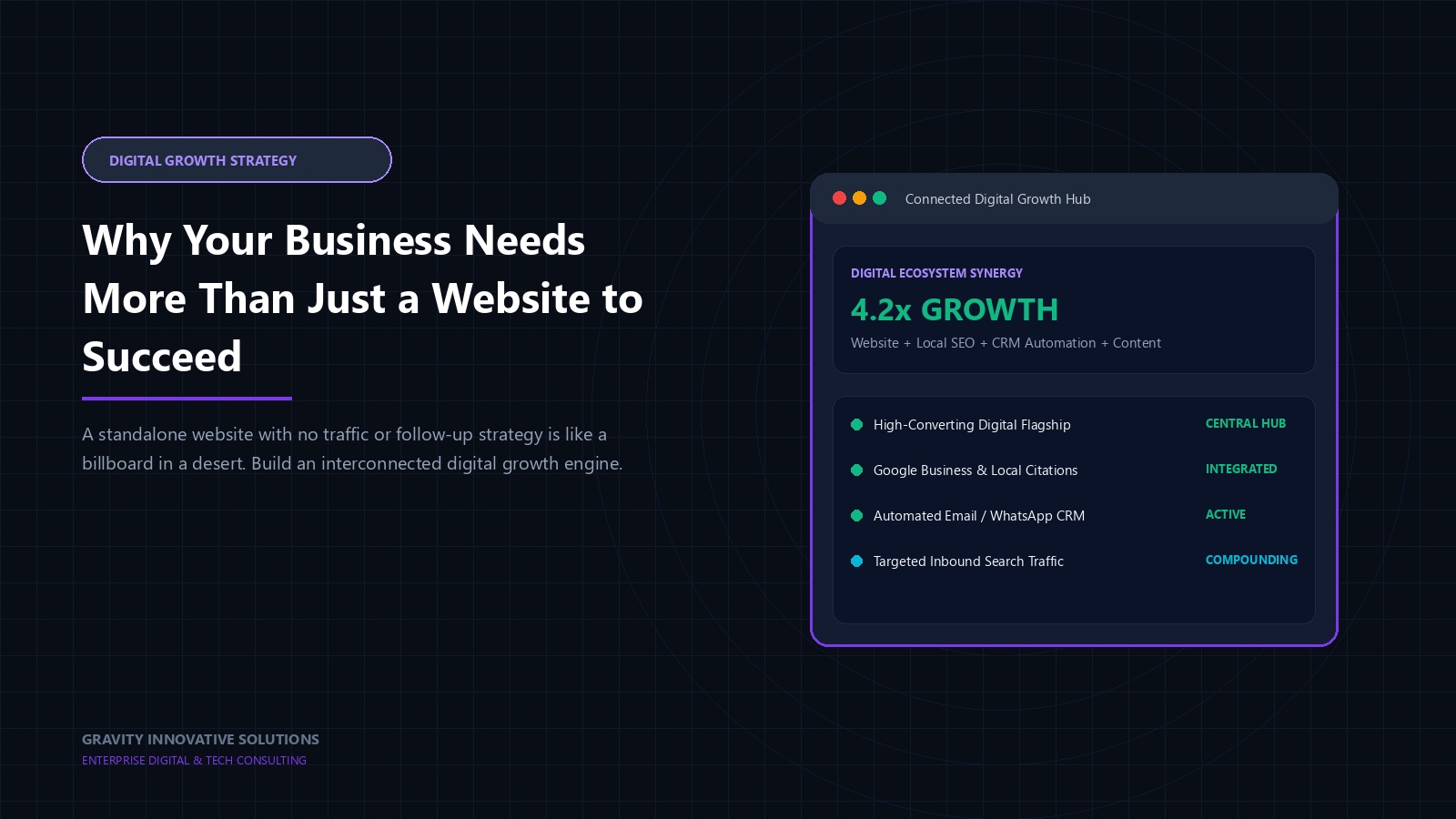
Think about how a typical customer actually finds and evaluates a business today. They rarely type a website address directly unless they already know the brand. More often, they search for a service, scroll past paid ads, scan the map listings, check a couple of reviews, glance at a social profile for signs of recent activity, and only then click through to a website to confirm details and decide.
At almost every one of those steps, the website itself plays no role. It only enters the picture once trust has already been partly established elsewhere. That means a brilliant website attached to a thin, inactive online presence may simply never get the traffic it deserves.
There's a second issue too: even visitors who do reach your website need a reason to act once they're there, and a reason to come back. Without ongoing content, offers, or visible proof that the business is active, a website can feel like a static brochure rather than a living part of the business.
There's also a quieter cost that rarely gets discussed: opportunity cost. Every month a website sits untouched while competitors actively build their presence is a month where the gap between you widens a little further. It's rarely dramatic in any single week, which is exactly why it's easy to keep postponing — there's no obvious crisis forcing the issue, just a slow drift that eventually becomes hard to ignore.
The site goes live and then gets left untouched for years, even as services, pricing or offerings change.
Without basic SEO, a website can be invisible to search engines no matter how good it looks.
No reviews, no social activity, nothing to reassure a first-time visitor that real people have had a good experience recently.
Without knowing which pages visitors leave from or what they search for, there's no way to improve the site intentionally.
Most visits now happen on a phone; a site that's awkward to use on mobile loses visitors before they even read anything.

Individually, none of these mistakes feels catastrophic. A missing review here, a slightly slow mobile page there. But they tend to accumulate quietly, and because no single mistake sends an alarm, businesses often go years without realising how much lost opportunity has built up around a perfectly good website that simply never got the support it needed to perform.

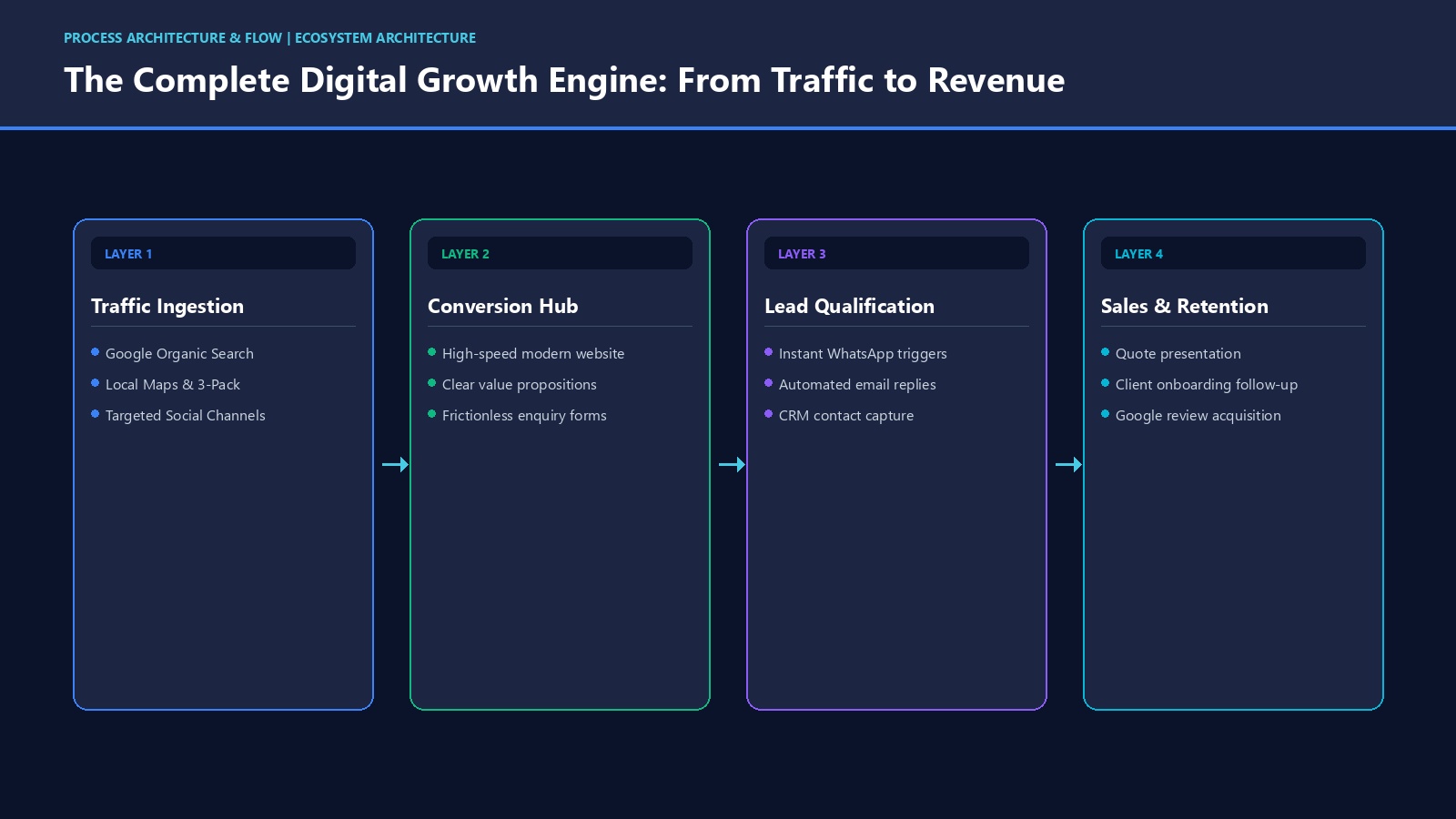
It helps to think of a digital presence less like a single object and more like a small, interconnected system:
None of these pieces needs to be perfect on day one. What matters is that they exist in some form and improve gradually, rather than one piece (the website) carrying the entire weight alone.
It's worth being honest about priority, too. Not every business needs every piece to the same degree. A professional services firm that wins most of its work through referrals might lean more heavily on a strong, credible website and a tidy LinkedIn presence than on consumer-style social media. A retail or hospitality business, by contrast, often depends far more on visual social content and a steady stream of reviews. The point isn't to build all five pieces equally — it's to deliberately decide which ones matter most for how your specific customers actually make decisions, rather than defaulting to "we built a website, so we're done."
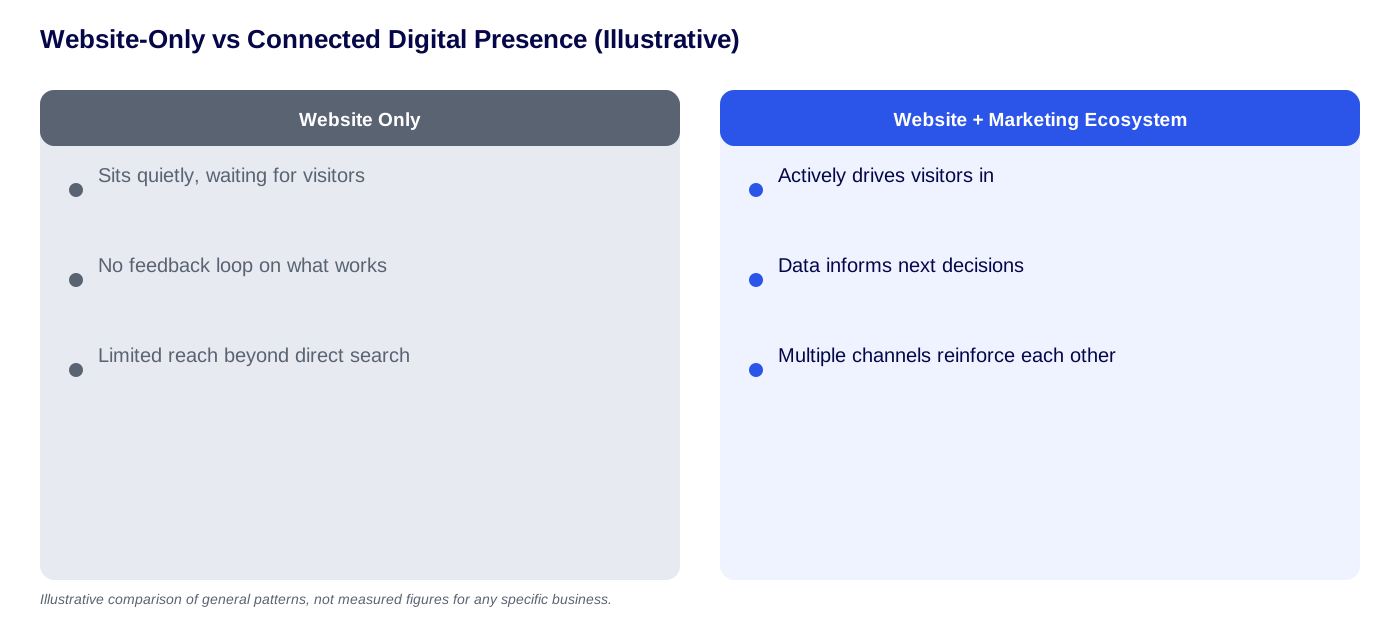
Imagine a small educational institute that invested in a modern, well-designed website two years ago, confident it would bring in enquiries on its own. Admissions stayed flat. Meanwhile, a newer competitor with a visibly simpler website posted regular updates on social media, responded to reviews (even critical ones) professionally, and kept its Google listing current with term dates and achievements.
Prospective parents comparing the two found the competitor easier to trust, not because the website was better designed, but because everything around it signalled an active, responsive institution. The original institute eventually added a basic content and review-response routine on top of its existing website, without redesigning anything, and began seeing more enquiries from people who said they had "looked them up online first."
This scenario illustrates a pattern we see often; it is not a documented result from a specific client engagement.
Rather than trying to do everything at once, a sensible sequence looks like this:
If you're also unsure whether your current online visibility is strong to begin with, our companion article on whether your business is invisible online walks through a simple self-check you can run today.
It also helps to set a realistic rhythm rather than a one-time push. A short monthly review — checking analytics, responding to any new reviews, posting an update, glancing at search rankings for your core terms — takes far less effort than most business owners assume, and it's the consistency that compounds into real results over a year, not any single dramatic action.
Doing all of this well, consistently, over time is where many businesses either run out of hours in the day or run out of technical know-how. That's a reasonable point to bring in outside support — but choose that support carefully. A vendor who only wants to sell you a one-off website build, without any conversation about SEO, content or measurement, is solving only one-fifth of the actual problem.
A genuinely useful technology partner should be comfortable talking about all five pieces of this ecosystem, even if they don't personally execute every one of them. If a web design company can't explain, even briefly, how their work connects to your SEO or your social presence, that's worth asking about directly before signing anything — a disconnected approach from day one tends to produce a disconnected result.
Your website should do more than simply exist online. It should build trust, attract the right audience and support your business goals.
Let's talk about building a connected digital presence — not just another website that sits quietly once it's launched.
Discuss Your ProjectA website is the foundation, not the whole structure. Without SEO, it may not be found; without active reviews and social proof, visitors may not trust it; without analytics, you won't know what to improve. The website works best as the hub a wider set of activities feeds into.
Start with a complete, accurate Google Business Profile and basic on-page SEO so the website can actually be found. After that, build a simple review-collection habit and pick one social platform to maintain consistently, rather than spreading thin across many.
Not in the same way a retail or consumer brand might. For B2B, a well-maintained LinkedIn presence and strong website content usually matter more than frequent consumer-style social posting. The right mix depends on where your buyers actually look.
Start with where your current and potential customers already search or spend time, and where your competitors are visibly active. A short audit of your existing presence usually reveals the one or two gaps causing the most lost opportunity.
Many small steps — claiming listings, asking for reviews, posting consistently — can be done in-house with discipline. Technical SEO, content strategy and analytics interpretation usually benefit from experienced help, especially once you want measurable, compounding results.
This varies by channel and starting point. Review collection and profile completeness can show visible change within weeks; SEO and content-driven growth usually take longer to compound. We avoid promising fixed timeframes without first reviewing your situation.