

Published: 30 October 2026
A shop owner in Thrissur once told us his business was "doing fine" — footfall was steady, regulars kept coming back, and he had never bothered much with a website. Then he noticed something odd: a newer competitor two streets away, with a smaller shop and less experience, was suddenly busier on weekends. Curious, he searched his own trade category on Google from his phone. His competitor's listing appeared with photos, reviews and a map pin. His own business did not appear anywhere on the first three pages.
That is the quiet, almost invisible way many otherwise healthy businesses lose ground today. Nothing about the business itself changed. What changed is where customers look first before they decide where to spend their money, and whether the business shows up when they look.
This is not a scare story about "going digital or dying." Plenty of businesses run profitably with minimal online presence, especially where relationships and referrals dominate. But for a growing number of categories — retail, healthcare, home services, education, hospitality, professional services — the first impression now happens on a screen, often before a customer ever walks in or calls.

The problem with being invisible online is that you rarely get direct feedback about it. Customers who can't find you don't call to complain — they simply choose whichever business did appear. You don't lose a sale with a bang; you lose it silently, and the lost opportunity never shows up as a line item anywhere.
Over time, this silent leakage compounds. Every customer your competitor wins through visibility is also a customer who may leave a review, recommend them to a friend, or return for a repeat purchase — further strengthening their online presence and widening the gap. Meanwhile, your own reputation stays frozen in whatever state it was years ago, even if your actual product or service has improved.
There's also a trust dimension. Many customers today treat a weak or missing online presence as a quiet signal that a business might be small, outdated, or less established — even when that's not true at all. Fairly or not, visibility has become a proxy for credibility.
In our experience working with businesses across Thrissur and Kerala, invisibility is rarely caused by one dramatic failure. It's usually a stack of small, understandable oversights:
Missing hours, categories, photos or a fully written description makes it harder for Google to understand and rank your listing.
An outdated, slow or non-mobile-friendly site can perform worse than having none at all, since it actively damages first impressions.
A different phone number on your website, Google listing and social page confuses both customers and search engines.
Review count and recency are a strong trust signal; silence here reads as inactivity, even to loyal customers.
Setting up a profile or website once and never updating it means your presence slowly falls behind competitors who keep investing.
Search engines and map platforms are, at their core, trying to match a searcher's intent with the most relevant, trustworthy and active businesses nearby. They look at signals: how complete and consistent your information is, how recently you've been active, how customers have rated you, and how well your website answers the kind of question someone is typing.
When a business has none of these signals, or weak and inconsistent ones, it isn't that the algorithm is "against" that business. It simply has nothing strong to rank. Meanwhile, a competitor who has even modestly invested in these basics gives the algorithm plenty of reasons to show them first.

This is why two businesses offering genuinely similar quality of work can have wildly different levels of enquiries. It isn't always about who is better — often it's about who is easier to find and easier to trust at first glance.
Picture two furniture retailers in the same part of Thrissur. Retailer A has run the business for over a decade, has a loyal customer base, and relies almost entirely on word of mouth and a signboard. Retailer B opened three years ago, has a modest but complete Google Business Profile with regularly updated photos, around twenty genuine customer reviews, and a simple website listing their catalogue and store hours.
When someone new to the area searches "furniture shop near me," Retailer B appears with a map pin, star rating and photos. Retailer A does not appear at all, despite having the longer track record and arguably the better stock. Over months, this difference nudges a steady trickle of new, unfamiliar customers — the ones with no prior relationship to either shop — toward Retailer B simply because they could be found and evaluated quickly. Retailer A's existing base stays loyal, but the business sees almost no growth from people outside that circle.
This scenario is illustrative, built to show a pattern we commonly observe, not a documented case study of a specific client.
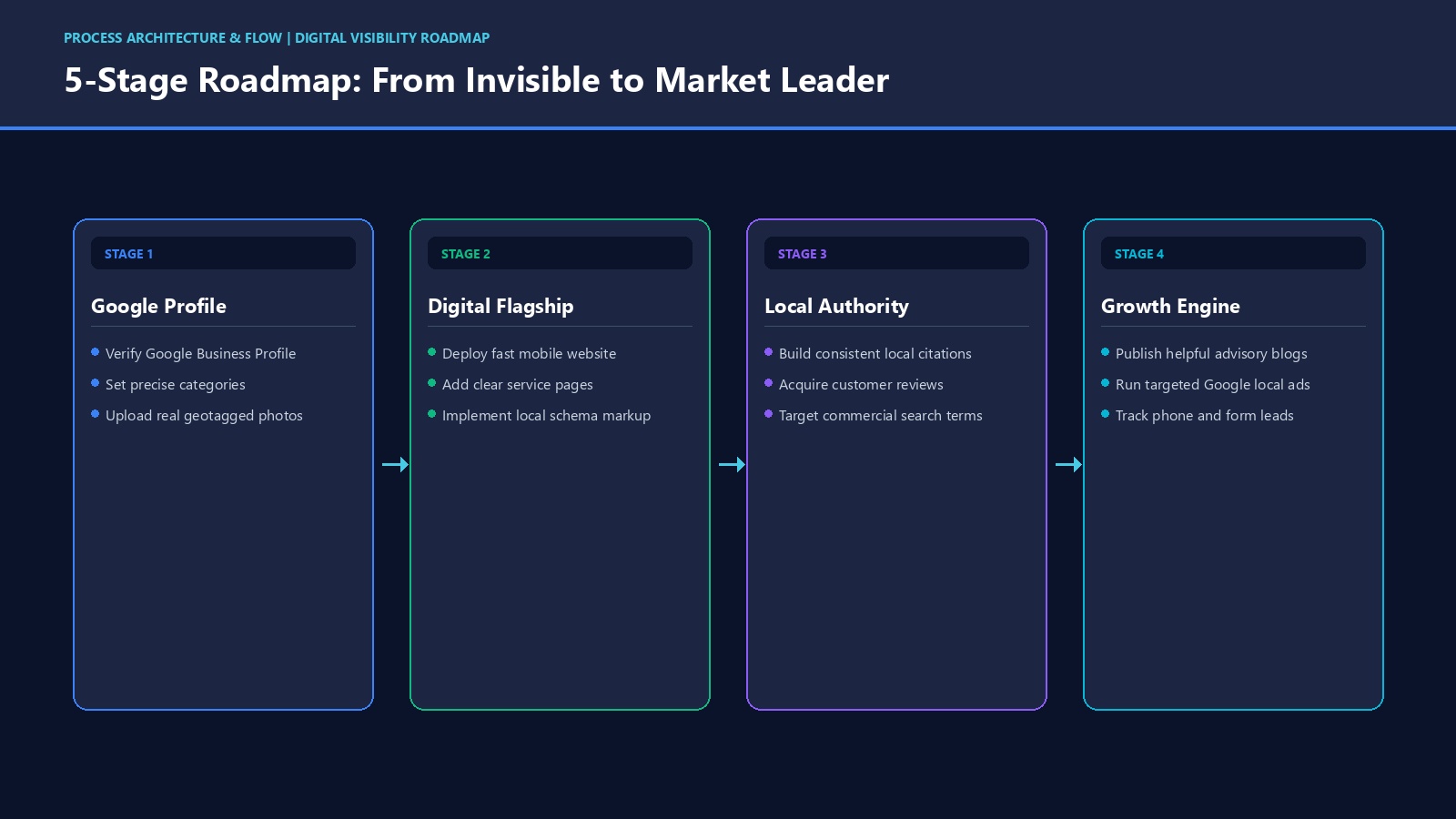
Fixing online invisibility is rarely about one big dramatic project. It's a sequence of deliberate, maintainable steps:
Local context matters too. If you want to understand who else is active in Thrissur's technology and services landscape, our directory of IT companies in Thrissur and broader Thrissur companies list are useful references for seeing how established and newer businesses position themselves online.
Before investing in anything elaborate, run through this short self-check:
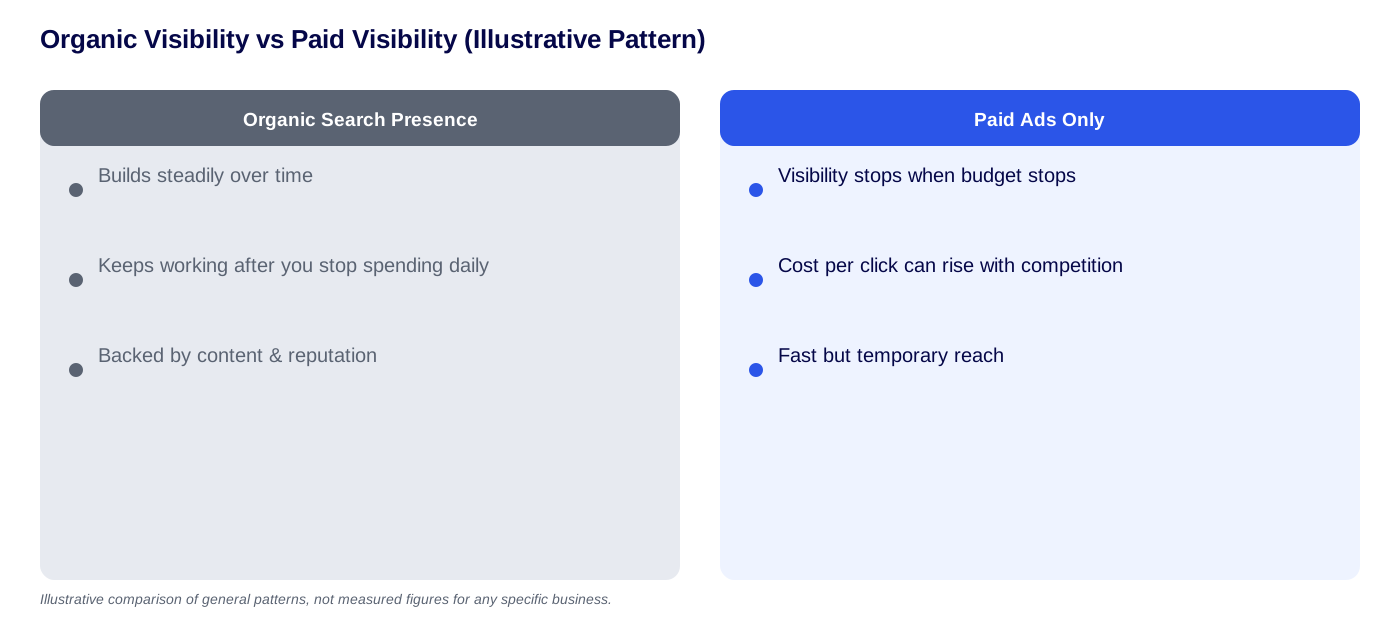
Some of this you can genuinely do yourself with a free afternoon and patience. Where it gets harder — and where many businesses either stall or make it worse — is in the technical and ongoing side: structuring a website so search engines can understand it, writing content that ranks without sounding forced, and maintaining consistency as your business changes over time.
If you decide to bring in outside help, be as careful choosing a partner as you would choosing any other vendor that affects your reputation. We've written a detailed guide on how to choose the right IT company without falling into the cheap-pricing trap, which applies just as much to visibility and SEO work as it does to web development.
Your website should do more than simply exist online. It should build trust, attract the right audience and support your business goals.
Talk to our team about a practical, honest review of your current online visibility — no exaggerated promises, just a clear picture and sensible next steps.
Discuss Your ProjectSearch your own business name and your main service plus your city from a phone that isn't logged into your accounts. If your business doesn't appear on the first page, on Google Maps, or on social platforms your customers use, you are effectively invisible to anyone who doesn't already know you.
Word of mouth still matters, but most people now verify a recommendation online before acting on it. If a friend recommends you and your business can't be found or looks outdated when they check, you can still lose that lead to a competitor who shows up better.
It's a strong starting point, but not the full picture. A complete, regularly updated profile with reviews, photos and accurate details helps, but it works best alongside a proper website and consistent information across directories and social platforms.
Basic visibility fixes like claiming and completing your Google Business Profile can show results within weeks. Broader improvements like website SEO and content typically take longer and depend on your industry, competition and starting point. We avoid quoting fixed timeframes without reviewing your specific situation.
Social media helps with engagement and brand recall, but it does not replace being found through search. Many customers specifically searching for a service use Google or Maps rather than scrolling social feeds, so you generally need both.
Costs vary widely depending on your current setup, industry competitiveness and goals. There is no single fixed price; a realistic figure only comes after understanding your specific requirements. Our general pricing guide explains the main factors that influence cost — treat it as a guide to what shapes a quote, not a quoted rate.