

Published: 30 October 2026
Three quotes land in your inbox for the same project. One is roughly double the others. It's tempting, understandably, to go with whichever number feels easiest to justify to a partner or a board — usually the lowest one, sometimes paired with the most confident promises: "ready in two weeks," "guaranteed page one ranking," "unlimited revisions, no extra cost."
This is one of the most common and costly decisions a business owner makes when bringing on a technology partner, and it rarely feels like a mistake at the time. It only becomes visible months later — in a website that needs to be rebuilt, a support request that goes unanswered, or a scope that quietly shrank from what was originally discussed.
None of this means every low quote is dishonest, or every expensive one is justified. It means price alone is a poor way to judge who will actually deliver what your business needs.
It's also worth acknowledging why this trap is so easy to fall into. Most business owners evaluating IT quotes aren't technical specialists — understandably, since that's not their job. Without an easy way to judge whether a quote reflects genuine quality or a corner-cutting shortcut, price becomes the default comparison point simply because it's the one number everyone understands. That's a reasonable instinct, but it's exactly why the questions in this guide matter — they give you other, more reliable signals to weigh alongside price.
A website, app or marketing campaign isn't a one-time purchase like office furniture. It's closer to a relationship — one that involves your business's reputation, customer data, ongoing updates and, often, your ability to generate revenue. A poor decision here doesn't just cost the original project fee; it can cost months of delay, a second project to fix the first, lost customer trust, and the opportunity cost of time spent managing a difficult vendor instead of running your business.
Unrealistic promises compound this risk. A vendor who guarantees results no one can honestly guarantee — a specific search ranking, a fixed number of leads, an impossibly fast delivery for a complex build — is either inexperienced about what's actually achievable, or aware the promise is false and comfortable making it anyway. Neither is a good sign.
There's a psychological pattern worth naming too: a confident, fast "yes" to every request can feel reassuring in the moment, especially compared to a more measured vendor who asks careful questions and gives honest, sometimes less exciting answers. But that measured response is usually the better signal. Technology projects have real constraints — time, budget, complexity — and a vendor who acknowledges them upfront is generally more trustworthy than one who tells you exactly what you want to hear.
Without comparing what's actually included, a lower price can hide a far smaller scope or lower-quality execution.
Choosing whoever can start immediately, without checking whether they actually understand your industry or goals.
Verbal understandings are easy to dispute later, especially around scope changes and ownership of the finished work.
Some vendors quote as a full team but subcontract the actual build, with little oversight on quality or communication.
A low build price with no clarity on ongoing support often means you're on your own the moment something breaks.

A low build price with no clarity on ongoing support often means you're on your own the moment something breaks.

Any single red flag on its own might have an innocent explanation — a small team genuinely stretched thin, a reasonable request for a partial deposit on a large project. What should concern you more is when several of these appear together, or when a vendor becomes noticeably less transparent the more specific your questions get.
Picture a small retail business owner choosing between two web development quotes: one around half the price of the other, promising a "fully ready ecommerce store in ten days." Eager to launch quickly, the owner goes with the cheaper, faster option. The site is delivered close to on time, but within weeks, product images load slowly, the checkout occasionally fails on certain phones, and basic SEO elements — titles, descriptions, structured data — were never set up.
Fixing these issues costs more, in both money and time, than the original price difference between the two quotes. The business eventually brings in a second vendor to rebuild core parts of the site properly, effectively paying for the project twice.
This scenario illustrates a pattern we see discussed often in this industry; it is not a documented case from a specific client.
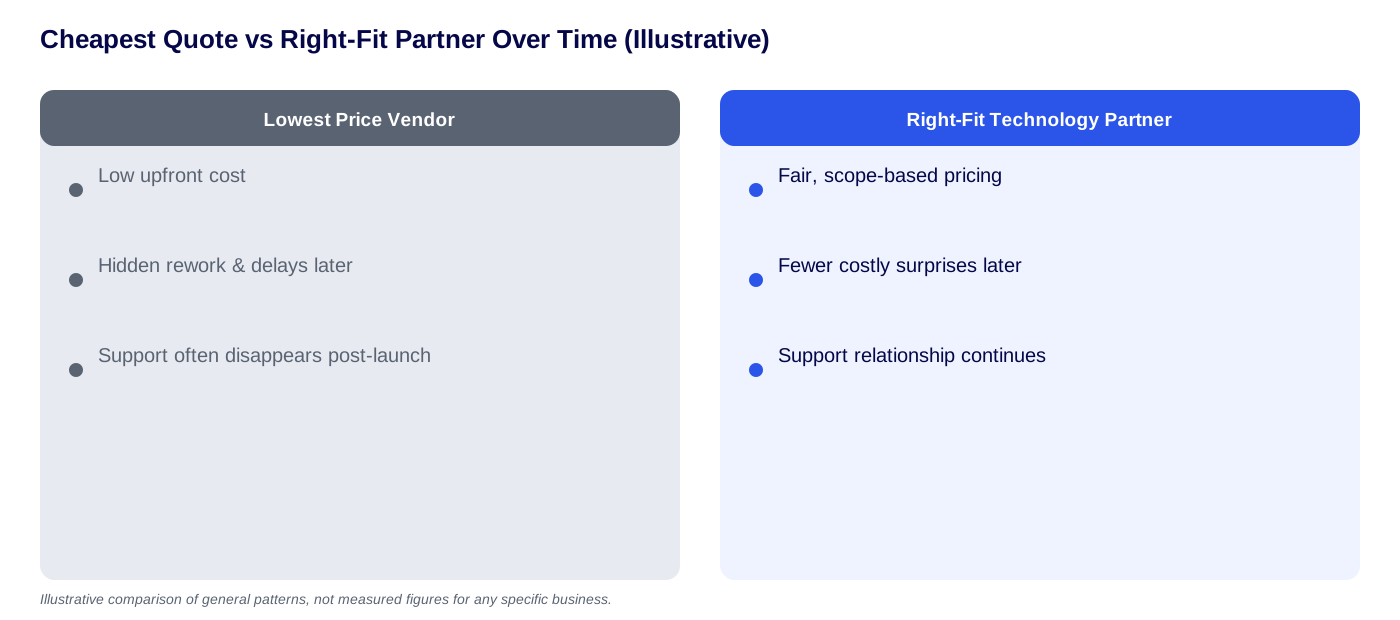
We won't put a specific number on this, because the real cost varies hugely by project and business. What's consistent is the pattern: underpriced projects tend to cut corners somewhere — in testing, in design iterations, in SEO fundamentals, or in post-launch support — and those corners usually surface as problems later, at a point when fixing them is more disruptive and more expensive than getting it right the first time would have been.
This doesn't mean the most expensive option is automatically the safest either. The goal isn't to spend more; it's to understand exactly what you're paying for, at any price point, before you commit. Our general pricing guide for SEO and web services in Kerala explains the main factors that typically drive cost up or down — treat it as a guide to shaping the conversation with any vendor, not as a quoted rate for your specific project.
A useful mental exercise is to ask any vendor, cheap or expensive, to justify their price against a specific list of deliverables. A fair quote should hold up to that scrutiny — you should be able to see roughly where the cost comes from: design hours, development complexity, number of pages or features, testing, and post-launch support. A quote that can't be broken down this way, regardless of the number attached to it, is harder to evaluate honestly and worth questioning further before you commit.
For more context on evaluating a potential partner's broader track record, our about page outlines how long we've been operating and what we focus on — a useful example of the kind of transparency worth expecting from any vendor you're considering. If your project involves a mobile app specifically, our dedicated page on mobile app development covers considerations unique to that kind of build.
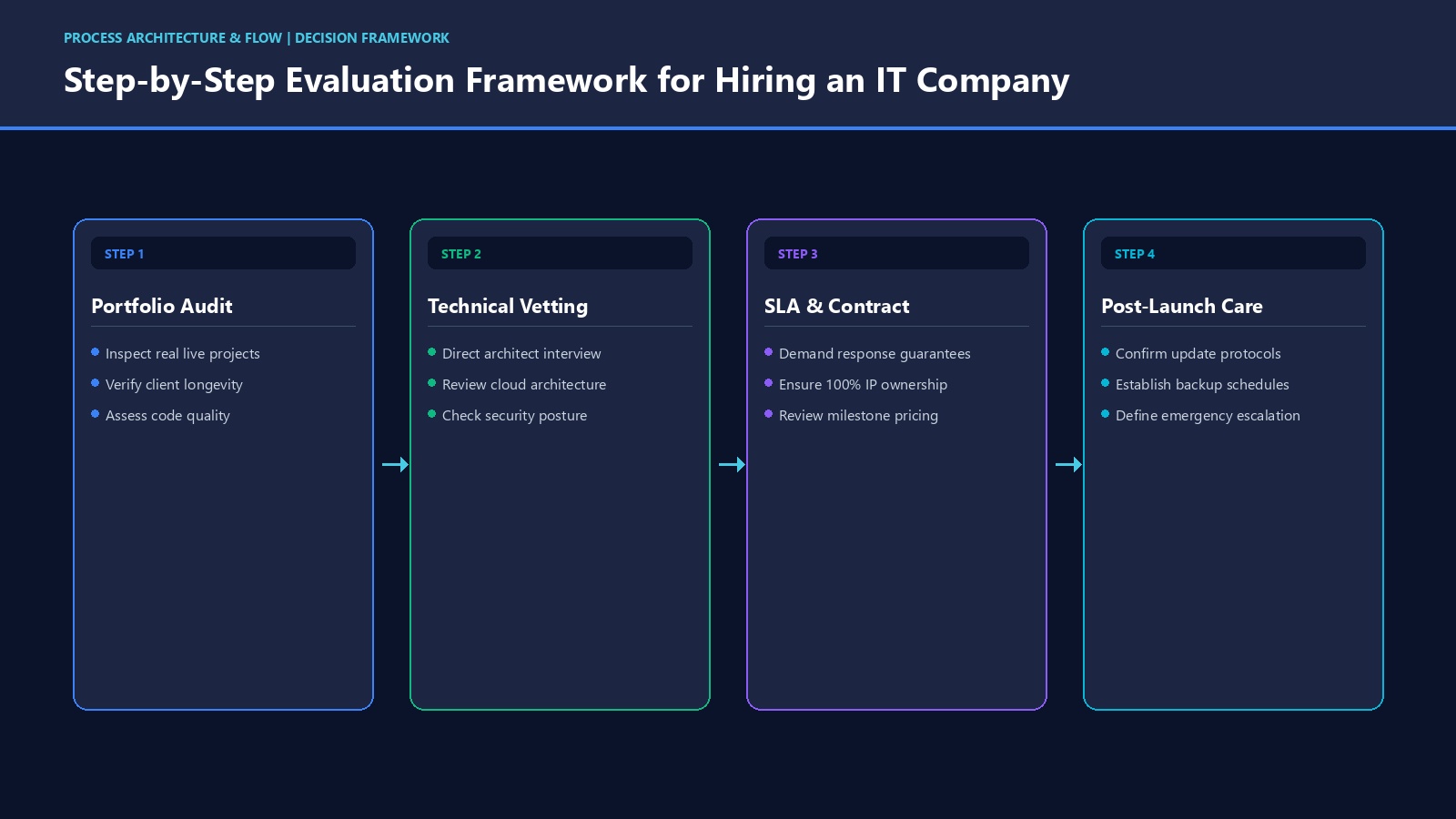
Ultimately, choosing an IT company well is less about finding a perfect vendor and more about reducing avoidable risk through a process you control. Every question in this guide exists to shift the decision away from a gut feeling about who sounds most convincing, and towards verifiable facts about who is actually likely to deliver what you need, on terms you can hold them to.
Your website should do more than simply exist online. It should build trust, attract the right audience and support your business goals.
We're happy to walk you through a transparent, itemised quote — and to answer the hard questions directly, before you commit to anyone.
Discuss Your ProjectNot automatically, but a very low quote compared to others usually means something is being cut: scope, quality, support, or the vendor's own margin to a point where the project isn't sustainable for them either. Ask specifically what's included before assuming it's a bargain.
Ask each vendor to break their quote down by the same deliverables: pages, features, design rounds, testing and support period. A like-for-like breakdown makes it much easier to see where prices actually diverge and why.
Timelines vary by scope and complexity, so there's no single universal number. Be wary of a vendor promising an unusually fast delivery for a complex project without explaining how, since rushed work often shows up later as bugs or rework.
Yes. A written agreement covering scope, cost, timeline, revisions, ownership of code and support terms protects both sides and prevents misunderstandings later. A vendor reluctant to put terms in writing is itself a warning sign.
Milestone-based payments tied to delivery stages are standard practice and protect you if something goes wrong midway. Full upfront payment removes your leverage entirely and is generally worth avoiding unless the vendor is well established and trusted.
There is no single fixed number — cost depends on scope, features, design complexity and the vendor's experience. Our general pricing guide explains the main factors that influence cost; treat it as a guide to shaping a conversation, not a quoted rate.