

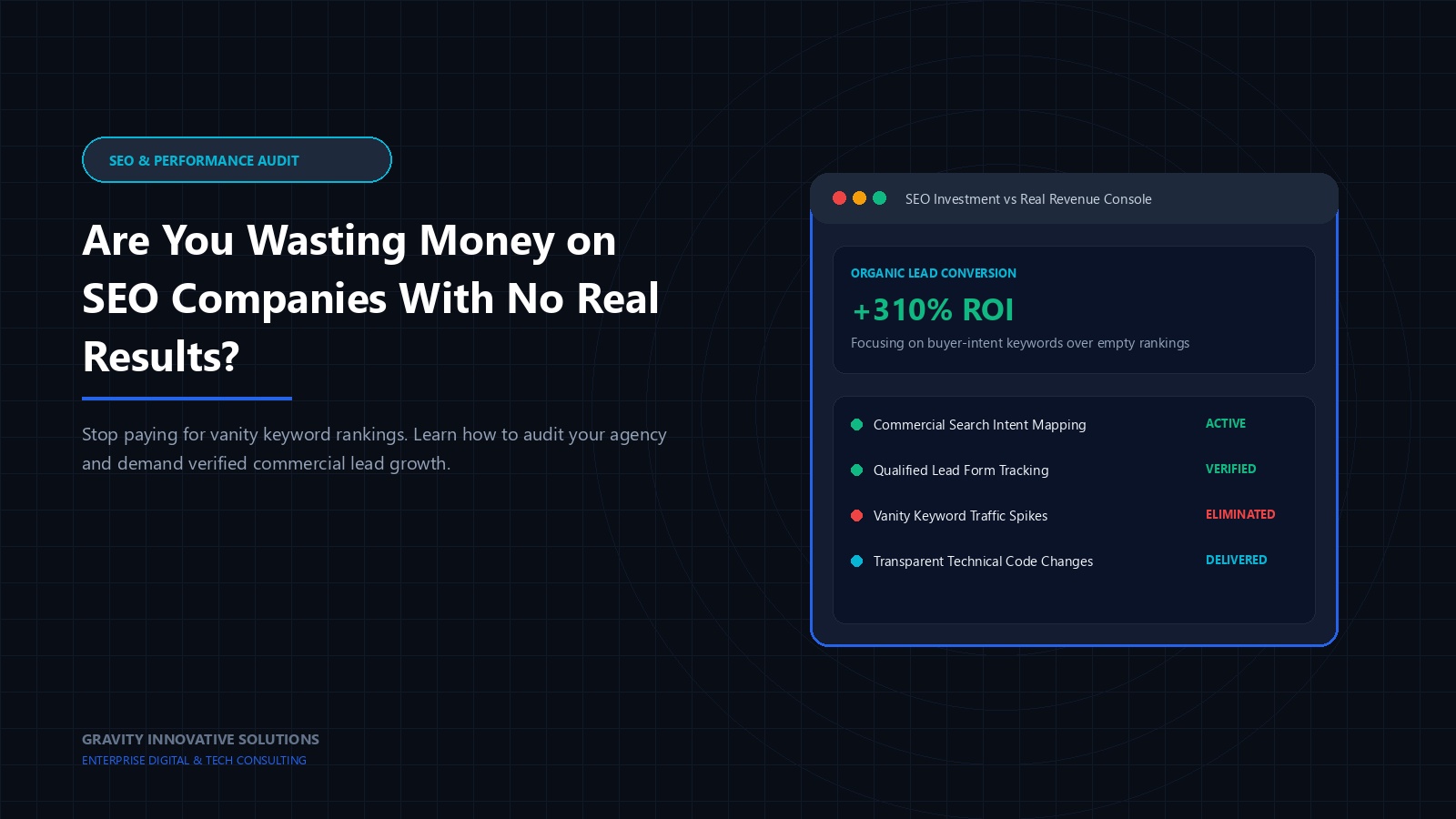
A trading company we spoke with in Thrissur had been paying an SEO agency for the better part of two years. Every month, a neat report arrived showing a handful of keywords sitting proudly on page one. The owner felt reassured. It wasn't until a slow quarter forced him to actually look at his website's Analytics that he noticed something strange: organic traffic hadn't grown at all in that time, and enquiries through the "Contact Us" form could be counted on one hand per month. The rankings were real. The business impact was not.
This is one of the more frustrating patterns business owners run into with SEO, because it doesn't look like being cheated. It looks like things are working. You get reports. You see keywords climbing. Nobody is lying to your face about a number on a screen. The problem is that the number on the screen was never the thing you were actually paying for — you were paying for more customers, and that part quietly never arrived.
Rankings on paper and silence on the phone can both be true at the same time — and that's exactly the problem.
Why This Disconnect Matters So Much
SEO retainers are usually paid month after month, often for a year or longer. If the spend isn't producing real outcomes, that's not a one-time loss — it's a slow, repeated drain that's easy to overlook precisely because each individual payment feels small compared to the total damage done over a year or two. It also carries an opportunity cost: every month spent with an underperforming agency is a month your actual competitors may be using to build genuine visibility instead.
There's also a trust cost that's harder to quantify. Business owners who get burned once by SEO promises often become permanently skeptical of digital marketing altogether, even when a properly run programme could genuinely help them. That skepticism, while understandable, can hold a business back for years.
Then there's the contractual trap many businesses don't notice until they try to leave. Several SEO agreements are structured with long lock-in periods, cancellation notice clauses, or language that makes switching providers feel riskier than it actually is. Combine that with a sense of "we've already invested this much, let's give it more time," and businesses often stay in underperforming arrangements for far longer than they would in any other vendor relationship that wasn't delivering.
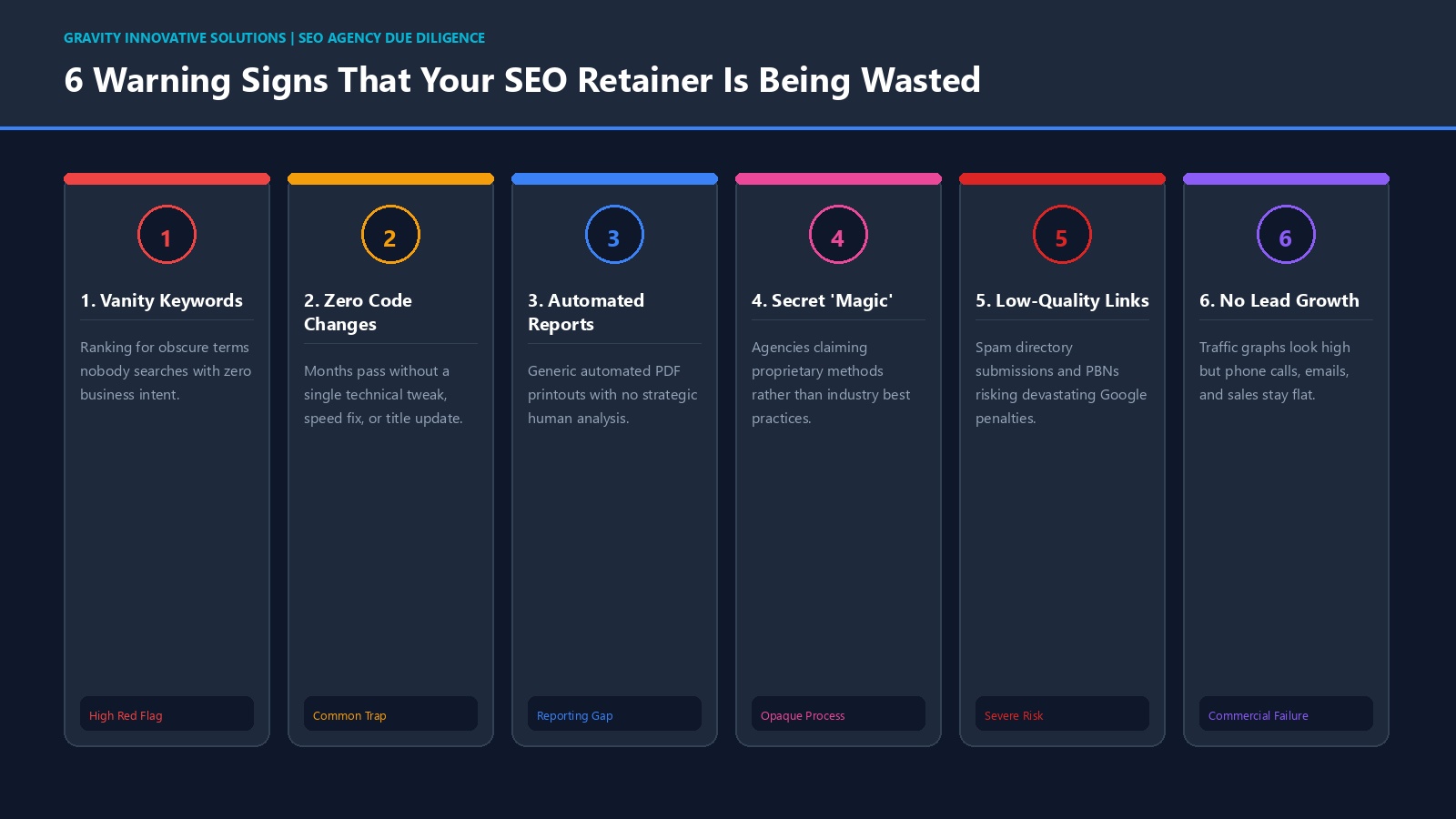
None of these signs alone proves a problem, but two or three appearing together is worth a direct conversation with your agency.
Common Mistakes Businesses Make When Hiring for SEO
- Judging the engagement purely by keyword position. A ranking is a means, not the end goal. The end goal is enquiries, bookings or sales.
- Not asking what "SEO work" actually includes. Many business owners sign a contract without ever getting a clear list of the tasks that monthly fee covers.
- Skipping the baseline. Without recording where traffic and enquiries stood before the engagement started, it's almost impossible to judge real progress later.
- Letting the agency hold all the accounts. When Analytics, Search Console and even domain or hosting access sit solely with the agency, you lose the ability to independently verify anything.
- Choosing based on price alone. An unusually low monthly fee often means thin, templated work spread across far too many clients to do any of them justice.
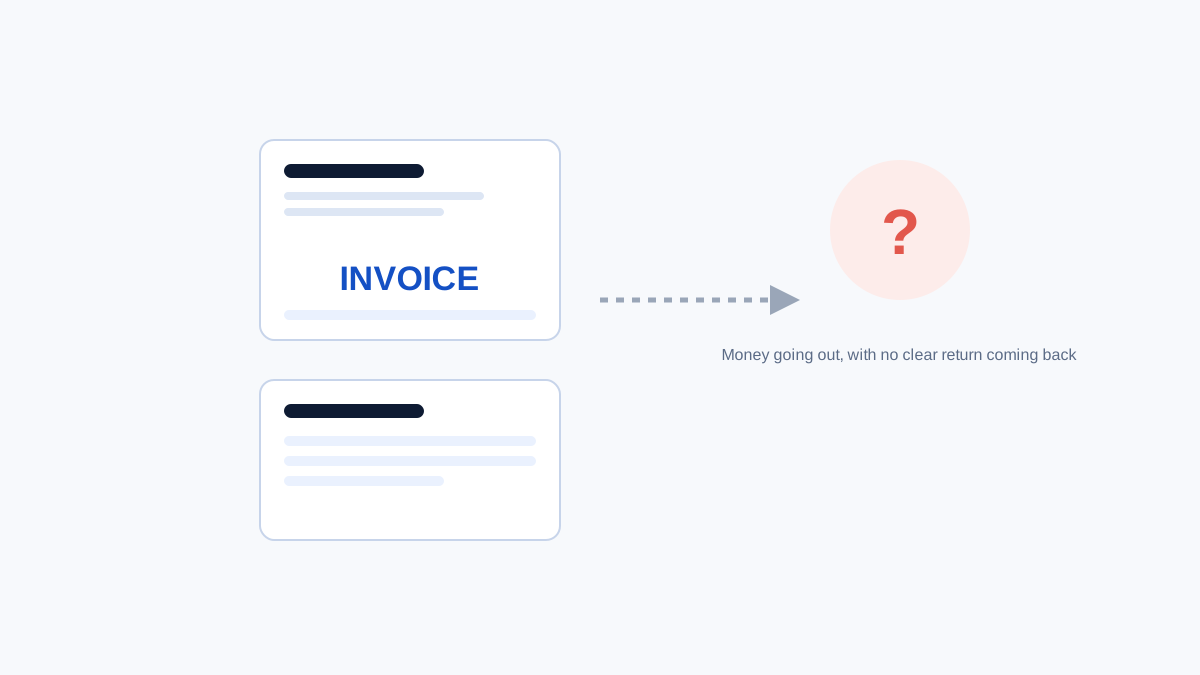
Each invoice on its own feels manageable. Added up over a year with nothing to show for it, the picture looks very different.
What's Actually Happening Behind the Rankings Report
Not every agency that produces disappointing results is acting in bad faith. Sometimes the retainer genuinely does go toward technical fixes, content and authority building, and the business grows because of it. Other times, and this is the pattern worth watching for, the retainer goes almost entirely into targeting a small set of easy, low-competition keywords that are simple to rank for but bring little real search demand, while the harder, more valuable work your business actually needs — content aligned with buyer intent, technical fixes, genuine authority building — never really happens.
Here's the technical reason this works as a tactic, in plain language: Google ranks pages for specific search phrases, not for a business as a whole. A phrase with very little real search volume is often much easier to rank for than a phrase real customers actually type. An agency under pressure to show "results" every month can quietly drift toward the easy wins, because a rising rank line in a report is simple to show a client, while the harder work of earning visibility for competitive, high-value terms takes longer and is less forgiving of shortcuts. The report still says "page one." It just doesn't say "for a phrase almost nobody searches."
This is also why relevance, not just position, deserves a place in every report you receive. A keyword worth ranking for should connect clearly to something a real customer would type when they already intend to buy, book or enquire — not simply the easiest phrase available to chase.
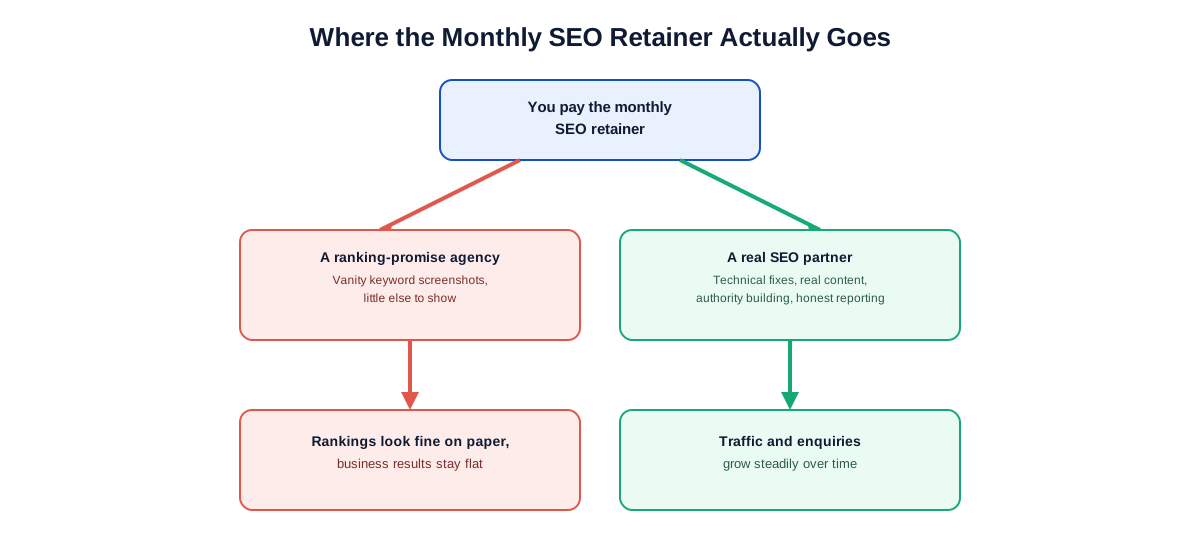
The same monthly payment, two very different destinations, and two very different outcomes six months later.
An Illustrative Scenario
Picture a boutique hotel on the outskirts of Thrissur — again, an illustrative example rather than a specific client. Their SEO agency reports strong rankings for phrases like "hotel with banquet hall interiors" and other oddly specific terms. Technically true, technically page one. But almost nobody searches for that exact phrase. Meanwhile, the hotel barely ranks for the searches that actually drive bookings, like "wedding venue Thrissur" or "banquet hall near Thrissur railway station." The monthly report looks successful. The booking calendar tells a different story.
Compare this with a second hotel that insists on reviewing rankings alongside actual booking enquiry numbers every month. When a keyword ranks but bookings don't follow, that's flagged and investigated immediately rather than quietly repeated the following month. The difference isn't the SEO knowledge involved — it's whether anyone is actually accountable for the business outcome, not just the ranking number.
A second illustrative scenario involves a small manufacturing unit paying a fixed monthly fee for "complete SEO management." Eighteen months in, the owner finally asked a straightforward question in a review call: "Can you show me which of these rankings actually brought us an enquiry?" The silence that followed was telling. Not because the agency was necessarily dishonest, but because nobody, on either side, had ever set up reporting that connected the two. The retainer had been paid faithfully every month against a plan that was never actually designed to be measured against business outcomes in the first place.
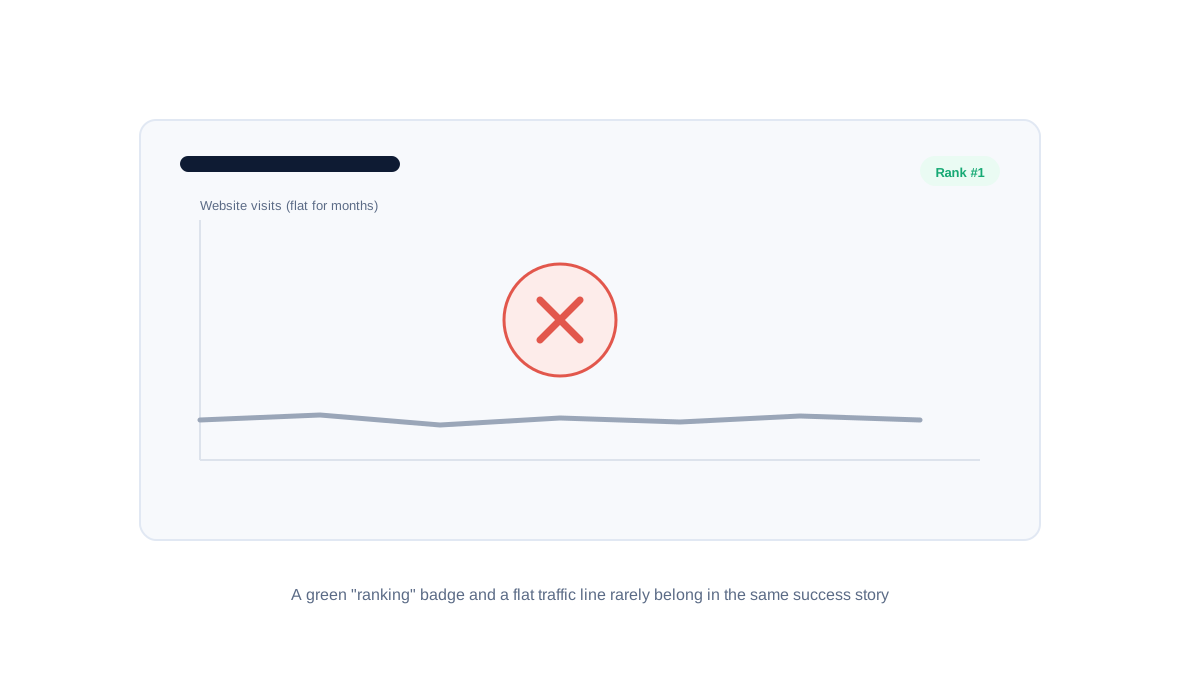
A green ranking badge and a flat traffic line rarely belong in the same success story.
Real SEO Partner vs. Ranking-Promise Agency
It's worth being direct about what actually separates a dependable partner from one coasting on vanity metrics.
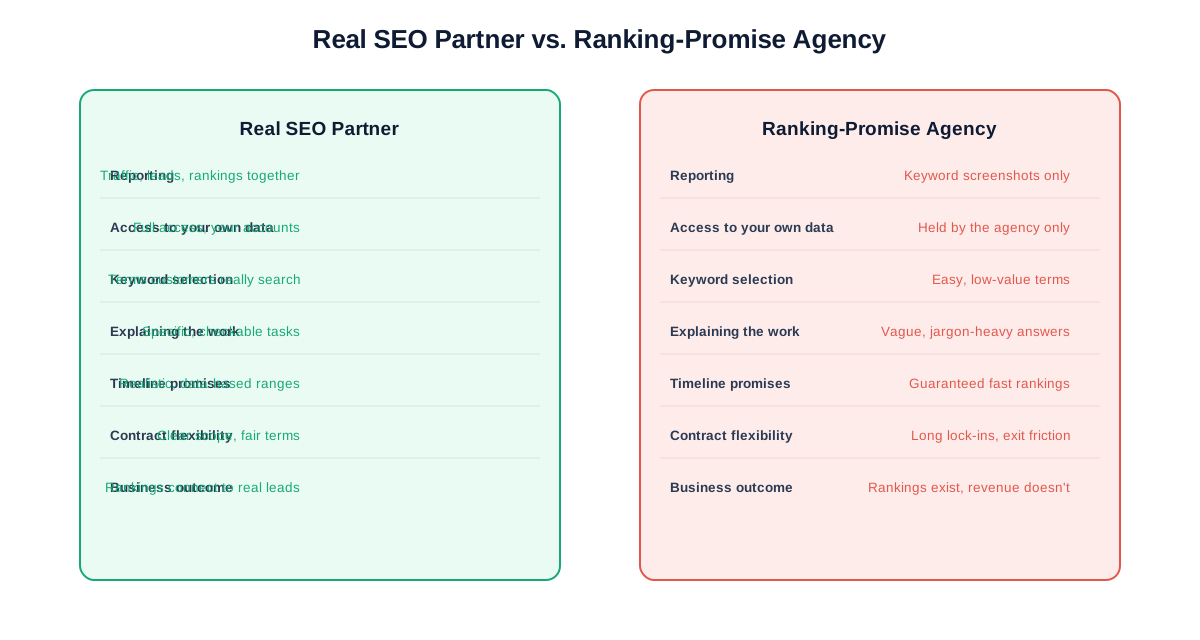
The honest version of this comparison usually becomes obvious within a single candid conversation.
Practical Steps If You Suspect You're in This Situation
None of this requires confronting your agency with hostility. A calm, fact-based conversation, backed by your own data rather than assumptions, usually surfaces the truth quickly either way — either the work is sound and the explanation will be clear, or the gaps will become obvious almost immediately.
- Request admin or at least viewer access to your own Google Analytics and Search Console if you don't already have it.
- Ask your agency for the specific keywords they're targeting, and check how much genuine search interest those terms actually carry.
- Compare organic traffic and enquiry numbers from before the engagement started to today — not just ranking positions.
- Ask directly: "What have you done for us in the last 90 days, in plain language?" and judge the answer on clarity, not confidence.
- Review the contract terms around cancellation and data handover before you need them, not after a dispute has already started.
- If you decide to move on, bring in a partner for a proper SEO audit and ongoing programme, ideally paired with a broader digital marketing strategy so visibility, content and conversion all work together rather than in isolation.
A Step-by-Step Evaluation Checklist for the Next 30 Days
- Week 1: Pull your own Analytics and Search Console numbers for the last 12 months and lay them next to every monthly report you've received.
- Week 1: List every keyword your agency claims to rank for, and note which ones you'd genuinely expect a paying customer to search.
- Week 2: Request a plain-language written summary of work completed in the last quarter, with dates and specifics, not general phrases.
- Week 2: Check whether you have independent access to your website's backend, domain and hosting, separate from the SEO agency.
- Week 3: Compare your findings against a second, independent opinion — a short paid audit from another credible provider is often worth the small cost.
- Week 4: Decide, based on evidence rather than inertia, whether to renegotiate scope, request a formal improvement plan, or begin transitioning to a new partner.
Weighing the Cost and the Risk
It's tempting to calculate exactly how much has been wasted, but we'd rather be honest than precise with a made-up figure: the real cost depends entirely on your monthly retainer, how long the underperformance has gone on, and what genuine results should have looked like for your industry. Ask your current agency directly for a breakdown of spend against outcomes over the last six to twelve months — a partner confident in their own work will have no trouble providing this. One that hesitates or deflects has told you something important without saying a word.
How to Identify the Right Partner Going Forward
The single best filter is transparency: a partner willing to show you real numbers, explain real work, and tie both back to business outcomes rather than isolated rankings. Our detailed guide on choosing the right SEO company in Thrissur and Kerala breaks this down into a practical evaluation framework you can use with any agency, including your current one.
Gravity Innovative Solutions has been doing this work in Thrissur and across Kerala for over 13 years, and the approach is straightforward: report on business outcomes, give clients access to their own data, and be upfront about what SEO can and can't realistically promise.
Conclusion
Paying for SEO isn't the mistake. Paying for SEO without ever checking whether it connects to real enquiries is. Your website should do more than simply exist online. It should build trust, attract the right audience and support your business goals, and that's a standard worth holding any agency, including one you've worked with for years, accountable to.
Related reading: 10 False Promises SEO Agencies Make That Could Cost Your Business Thousands and Are You Paying for SEO Every Month Without Knowing What Your Agency Is Actually Doing?