

An interior design studio owner once shared a proposal she'd received from an SEO agency, genuinely unsure whether to be excited or suspicious. It promised a guaranteed first-page ranking within two weeks, for over 300 keywords, with a money-back clause buried somewhere in paragraph nine of a contract she admitted she hadn't fully read. She wasn't being careless. The pitch was simply built to sound reassuring to someone who had no easy way to verify any of it.
That's the real problem with false promises in SEO. They're rarely obvious lies. They're confident-sounding claims dressed in just enough technical language to feel credible, aimed at business owners who reasonably assume an expert wouldn't put something in writing unless it was true. Below are ten of the most common ones, explained in plain terms, so you can spot them before they cost you time, money and trust.
It's worth saying upfront: most people working in SEO, including at agencies that make some of these claims, aren't cartoonish villains. Many genuinely believe their own pitch, repeat what they were taught to say, or simply haven't been challenged on it before. That doesn't make the promise any more deliverable. It just means the responsibility for catching it usually falls on you, the business owner, before the contract is signed rather than after.
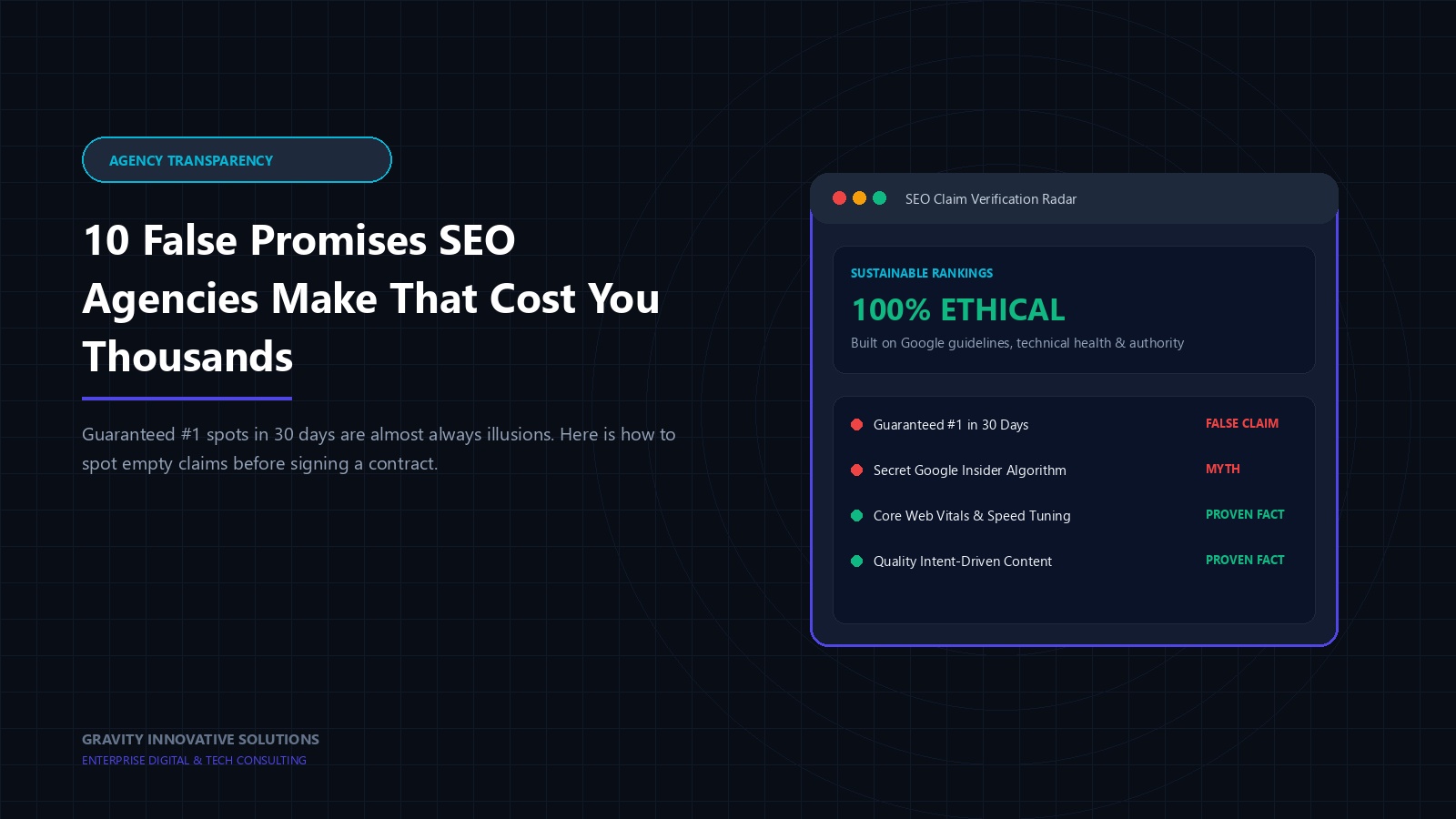
The pitch is written to reassure you. The fine print is where the real terms usually live.
The 10 False Promises, and Why Each One Falls Apart
1. "We guarantee a #1 ranking on Google."
No agency controls Google's ranking algorithm, and Google itself doesn't sell guaranteed organic positions to anyone. A written ranking guarantee is a promise about an outcome the agency simply does not have the power to control.
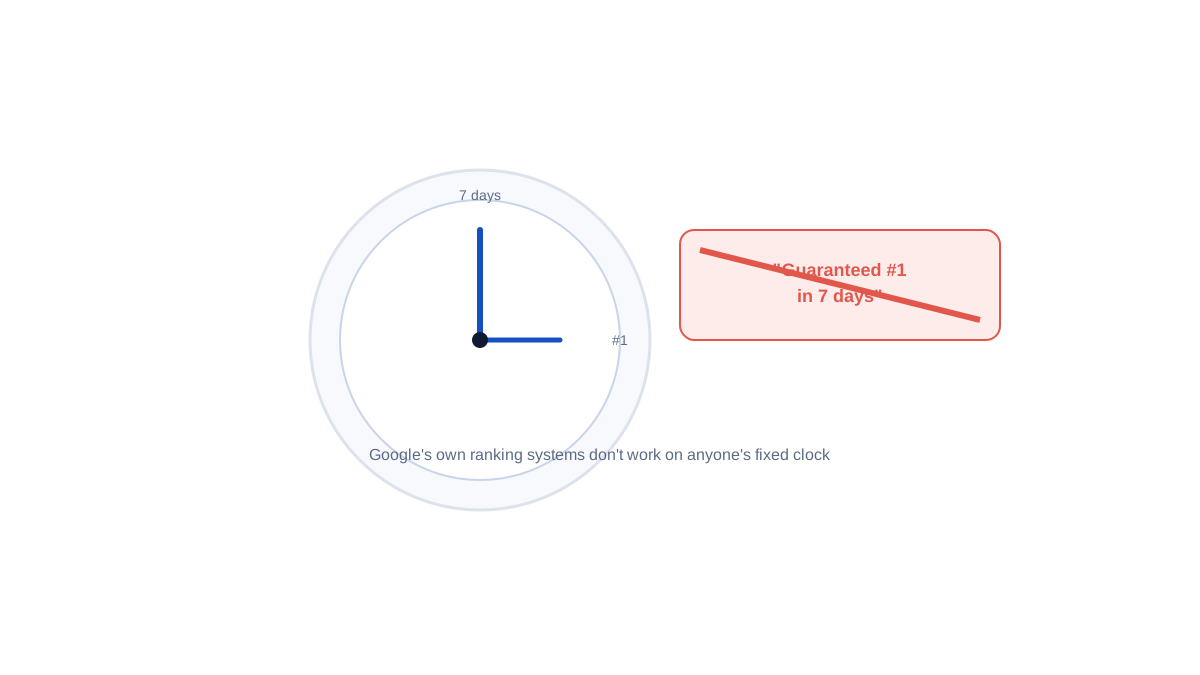
2. "You'll see results in 7 to 14 days."
Genuine, lasting ranking improvement for competitive terms typically takes months of consistent work. Claims of results within days usually either refer to meaningless low-value keywords or rely on shortcuts that risk a penalty later.
3. "We have a special relationship with Google."
There is no backdoor relationship that manually boosts a website's position. Google's search results and its advertising sales relationships are kept deliberately separate from organic ranking outcomes.
4. "We'll rank you for 300+ keywords."
A long keyword list sounds impressive on a slide, but volume without relevance rarely translates into real enquiries. A shorter list of terms genuine customers actually search is almost always worth more.
5. "This is a one-time setup, and you're done forever."
Search engines continually reassess content, competitors and relevance. A site left untouched after a single round of work tends to lose ground over time as competitors keep investing.
Each warning sign on its own might be explainable. Several appearing together usually isn't.

6. "Our backlinks are completely safe, no matter how many."
Large volumes of low-quality backlinks acquired quickly are a known risk factor for search penalties, not a safe shortcut. Authority built this way can do more harm than good.
7. "You don't need to see the technical reports in detail."
Any legitimate SEO work can be explained in plain language and shown with real data. A partner who discourages scrutiny of their own reporting is asking you to trust blindly rather than verify.
8. "Our SEO process works identically for every industry."
Search intent, competition levels and customer behaviour vary significantly between industries. A templated, one-size-fits-all approach rarely accounts for what actually matters in your specific market.
Google's ranking systems don't run on anyone's promised schedule, including yours or your agency's.
9. "Rankings are all that matter — don't worry about the rest."
A ranking that doesn't lead anyone to actually enquire, book or buy has delivered nothing of real value. Conversion, content quality and site experience matter just as much as the position itself.
10. "Sign a 2-year contract and just trust the process."
Long commitments without clear milestones or a fair exit path remove your ability to course-correct if results genuinely disappoint. Trust should be earned through visible, checkable progress, not required upfront by contract.
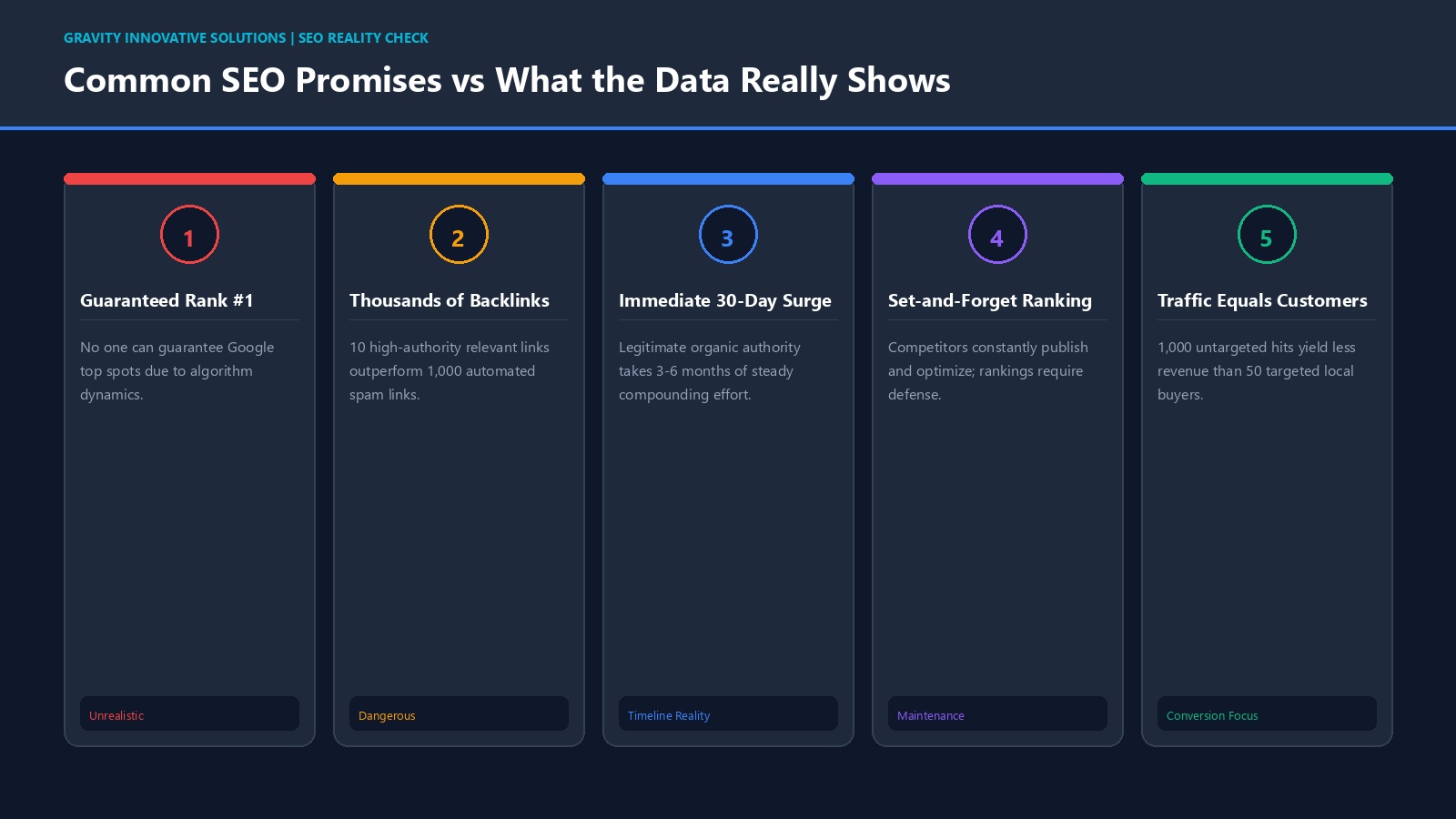
All ten, side by side — worth keeping as a quick reference the next time a pitch sounds a little too confident.
Why This Matters Beyond the Money
The direct financial cost of falling for one of these promises is real, but it's not the only cost. Businesses that get burned often lose months waiting for results that were never coming, while their actual visibility problem goes unaddressed and competitors keep moving forward. There's also a confidence cost: once bitten, many owners stop investing in SEO altogether, even though a properly run programme could genuinely help them.
There's a compounding element too. Twelve months lost to an arrangement that was never going to work isn't just twelve months of wasted invoices — it's twelve months a genuine competitor may have spent building real content, real backlinks and real reviews. Catching up from that position takes longer than starting from a level field would have, which is exactly why the earlier you question a shaky promise, the cheaper the mistake is to correct.
Why Capable Business Owners Still Fall For These Promises
It rarely has anything to do with being careless. A guarantee feels reassuring precisely when you don't have the technical background to challenge it, and most business owners have better things to do than study how search algorithms work. Confident language, a professional-looking proposal document and a sense of urgency — "this offer is only valid this week" — are persuasion tactics that work on smart, busy people in any industry, not a special weakness unique to SEO buyers. Recognising that these are standard sales tactics, rather than a personal failure to "do your research," makes it easier to slow down and ask the questions below without feeling foolish for not asking them sooner.
How to Vet Any Promise Before You Sign
You don't need to be an SEO expert to protect yourself. A simple filter works for almost every claim you'll hear.
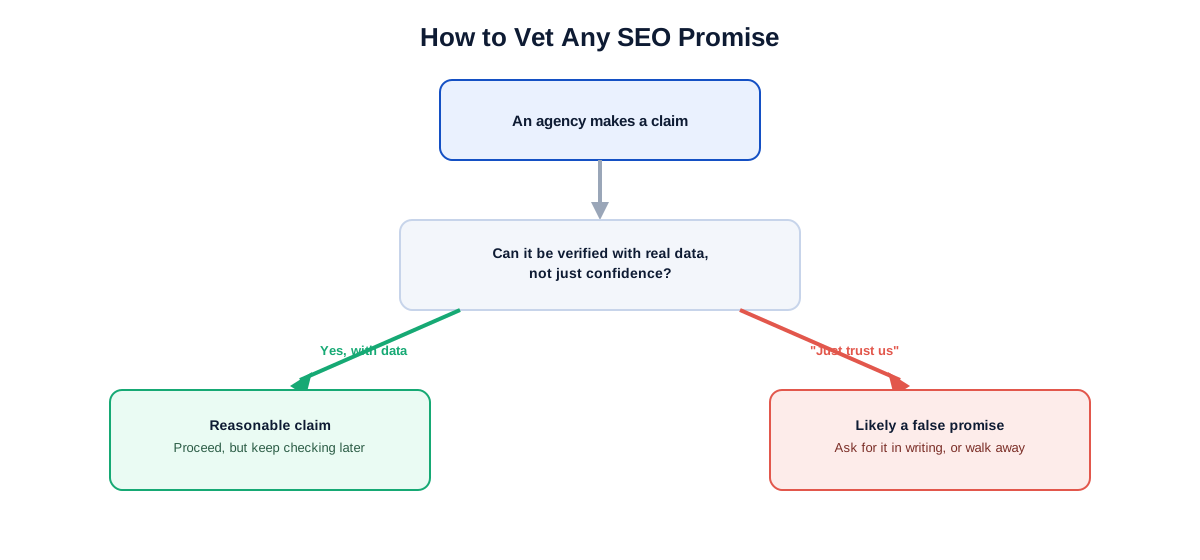
If a claim can't be backed by real, checkable data, treat it as a false promise until proven otherwise.
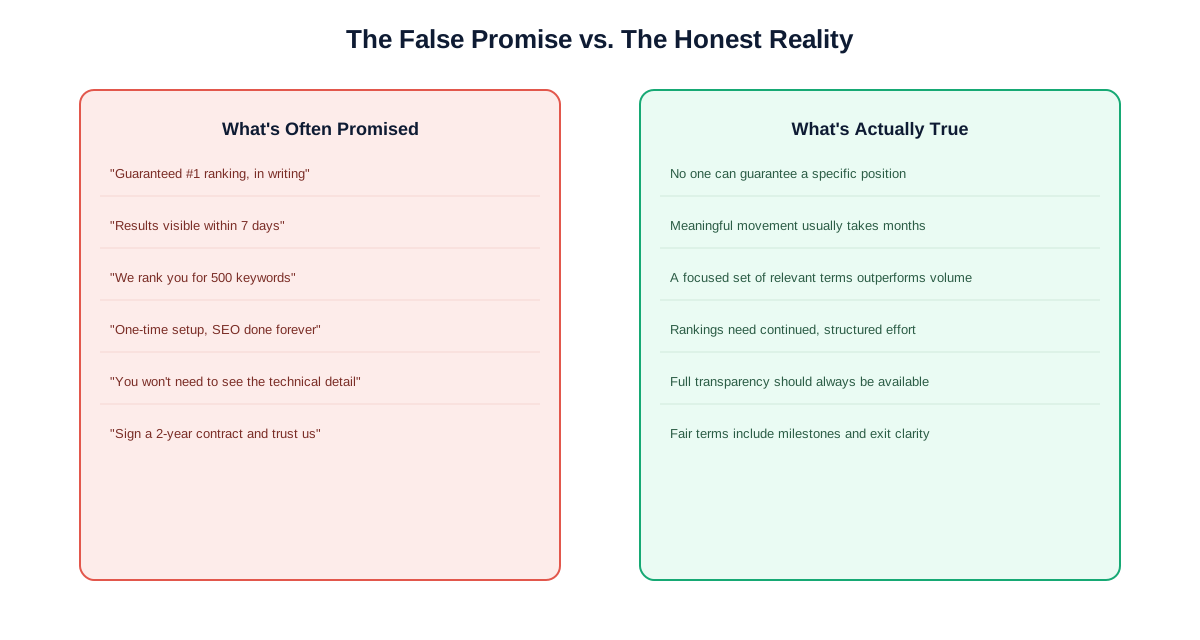
Reading the "honest reality" column out loud during a sales call is often the fastest way to see where a pitch stands.
An Illustrative Scenario
Consider a small logistics company — illustrative, not a specific client — that signed with an agency promising "guaranteed top 3 rankings in 30 days" for a flat annual fee paid upfront. Thirty days passed with no visible movement. The agency's response leaned entirely on reassurance: "these things take time, trust the process." Eleven months in, with no refund clause they could actually invoke and no real traffic growth to show for it, they switched partners and started again almost from zero, a full year later than if they'd asked harder questions at the start.
A second illustrative example: a boutique online store owner was told her product pages would rank for "500+ high-value keywords." The monthly report did list hundreds of ranking terms, but almost all of them were long, unusual phrase variations nobody actually searched, generated automatically rather than written with customers in mind. Meanwhile the handful of terms that genuinely mattered to her business — the product category names people actually type into Google before buying — were never mentioned in a single report. The keyword count looked impressive. The sales dashboard told the real story.
A Pre-Signing Evaluation Checklist
This checklist is meant to be used during the sales conversation itself, not after you've already paid the first invoice. A confident, trustworthy partner will welcome every one of these questions; a shaky pitch tends to reveal itself quickly once you start asking for specifics instead of reassurance.
- Ask for two or three client references you can actually contact directly, not just testimonials on a website.
- Request a sample report from an existing client (with details anonymised) to see what real reporting looks like.
- Have them explain, in plain language, exactly what work will happen in the first 90 days.
- Check the contract specifically for lock-in duration, cancellation terms and who owns the Analytics and Search Console accounts.
- Ask how they would define and measure success for a business like yours, specifically — not generically.
- Ask what happens, contractually, if agreed milestones aren't met by an agreed date.
- Get the full scope of work, keyword list and reporting format described in writing before any payment is made.
- Treat any guarantee of rankings or a fixed fast timeline as an automatic point of further questioning, not reassurance.
What This Actually Costs a Business
It's tempting to attach a round number to "what false promises cost businesses," but that figure depends entirely on the contract value, how long the arrangement runs, and what results a properly run programme would have delivered in that same period. Rather than quoting an invented statistic, ask any agency you're evaluating, including your current one, to show real numbers tied to real outcomes. Our SEO pricing guide for Kerala businesses is a useful reference point for understanding how fair engagements are typically structured.
How to Identify a Trustworthy Partner
The agencies worth working with tend to sound less exciting in the first meeting, not more. They talk in ranges, not guarantees. They want to show you data, not just confidence. If you're currently comparing options, our complete guide on choosing the right SEO company in Thrissur and Kerala walks through this evaluation in more depth, and pairs well with a broader look at structured SEO services and digital marketing done the honest way.
Gravity Innovative Solutions has spent over 13 years working with businesses across Thrissur and Kerala, and our proposals are intentionally written in plain, checkable terms rather than confident-sounding guarantees — because that's the standard we'd want applied to our own work too.
If you're unsure whether a promise you've already received falls into one of these ten categories, it's reasonable to simply ask for it in writing, with specifics, and see how the answer changes once that request is made. A genuine partner will tighten the explanation. A shaky one will usually soften the original claim instead.
Conclusion
None of these ten promises are illegal to say out loud, which is exactly why they persist. They rely on sounding reasonable to someone who isn't an SEO specialist, which is a fair description of most business owners, and nothing to be embarrassed about. Your website should do more than simply exist online. It should build trust, attract the right audience and support your business goals — and the agency you choose to help with that should be able to describe its work without needing you to simply take its word for it.
Related reading: Are You Wasting Money on SEO Companies That Promise First-Page Rankings but Deliver No Real Results? and Are You Paying for SEO Every Month Without Knowing What Your Agency Is Actually Doing?