

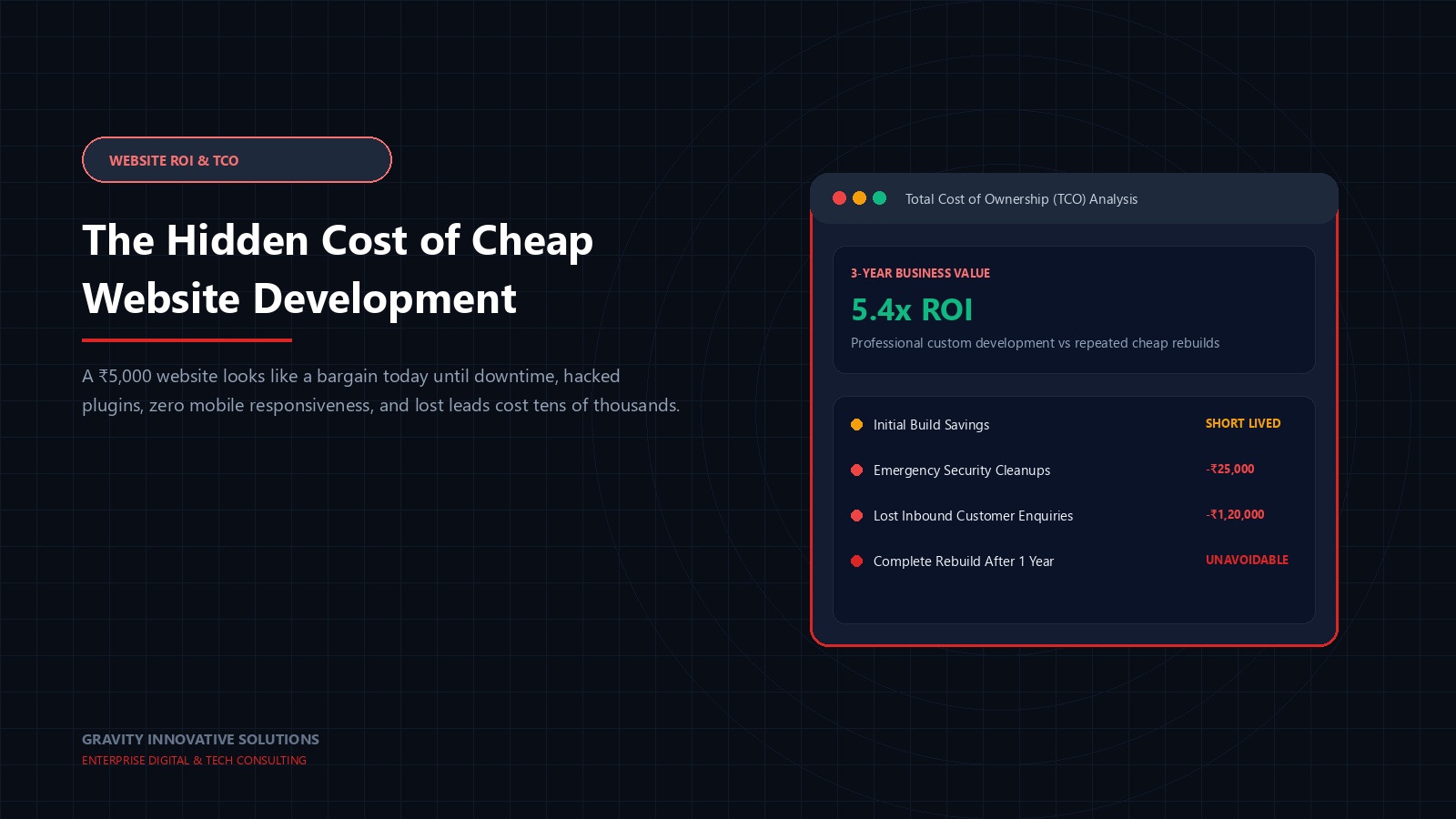
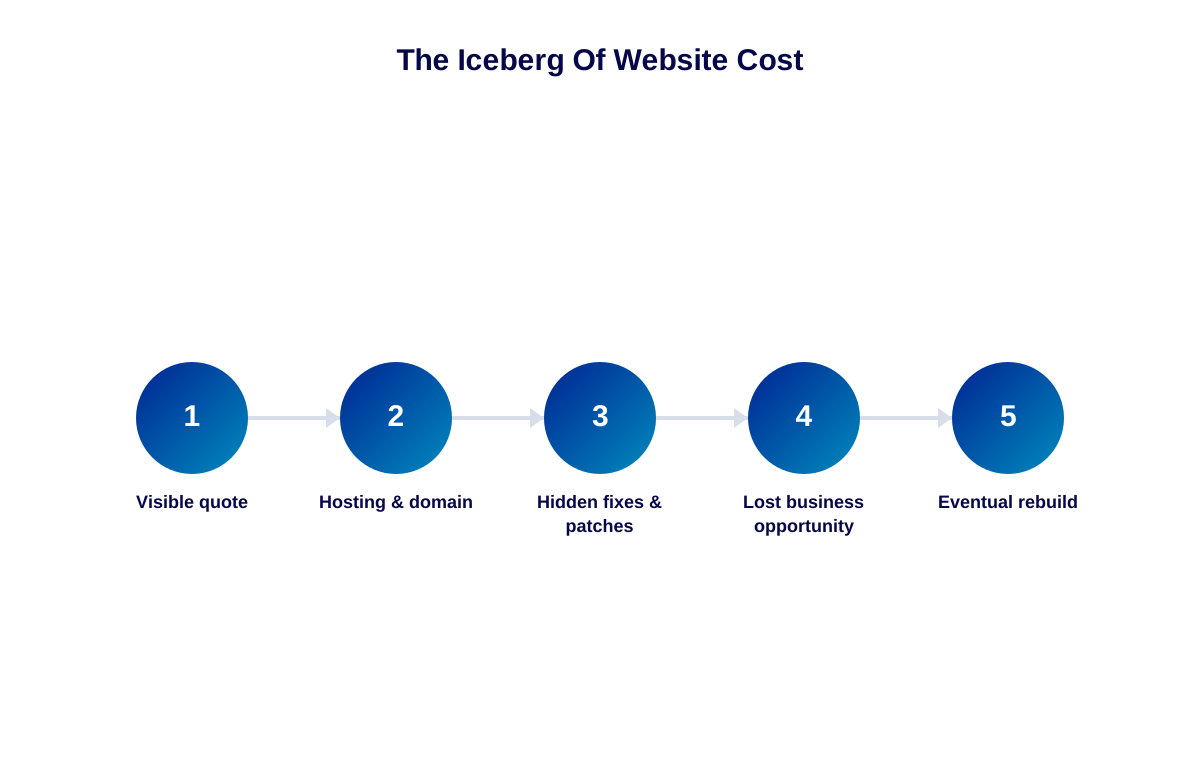
An invoice tells you exactly one number: what you paid to get the website built. It does not tell you what you will pay afterward to keep it secure, to fix what breaks, to replace what never worked properly in the first place, or to recover the business you quietly lost while the site underperformed. That second, invisible set of costs is what we mean by the hidden cost of cheap website development, and it is far more common than most business owners expect when they first sign off on a low quote.
This is not an argument that every inexpensive website is a trap, or that every expensive one is automatically sound. It is an argument for looking at total cost, not just the number on day one.
It is also worth being upfront about why this matters especially for small and growing businesses. A larger company can usually absorb an unexpected rebuild cost without much disruption. A small business often cannot, particularly if that unplanned expense arrives at the same time as other growth pressures. Understanding the likely shape of future costs before signing a contract is not caution for its own sake; it is simply responsible budgeting.
Why the Upfront Price Is Only Part of the Story
A website is infrastructure, not a one-off purchase. Like any piece of infrastructure, it needs upkeep: security patches, periodic content updates, hosting renewal, occasional redesign as the business grows. When a build is priced to cover only the initial construction and nothing else, those ongoing needs do not disappear — they simply arrive later, usually without warning, and often at a worse moment than if they had been planned for from the start.

Where the Hidden Costs Typically Come From
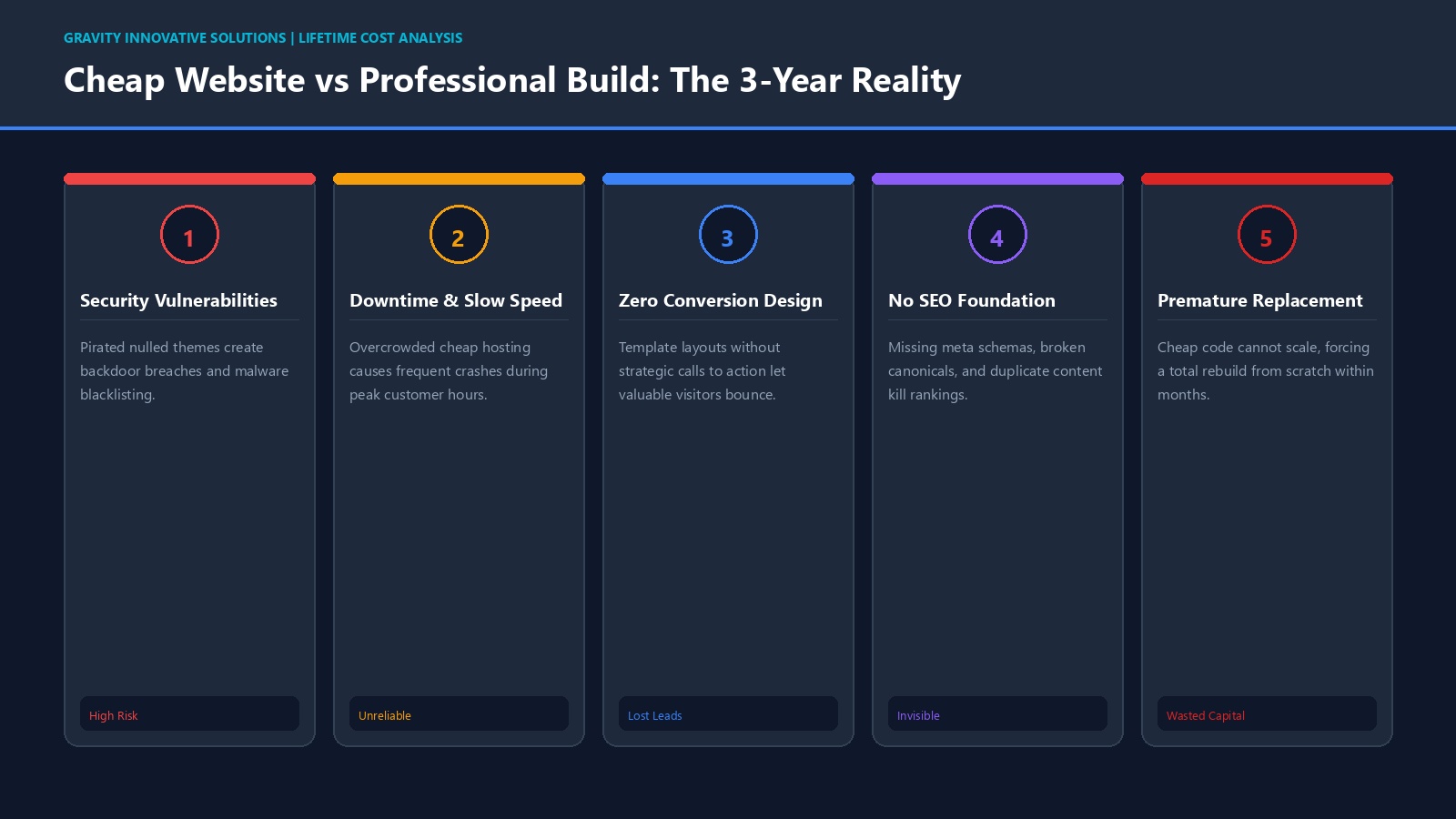
1. Security gaps discovered the hard way
A website built without basic security practices in mind can run quietly for months before a vulnerability is exploited. Fixing an active issue, communicating with affected customers if needed, and restoring trust afterward almost always costs more than building it securely the first time would have.
2. SEO structure that was never there
If a site was never built with search visibility in mind, the business may spend years wondering why it barely appears in local search results, effectively paying an ongoing cost in missed visibility that compounds the longer it goes unaddressed.
3. Performance problems that drive visitors away
Slow, unoptimised pages do not announce themselves as a cost. They simply reduce the number of visitors who stay long enough to enquire, a loss that is real but easy to overlook because it never appears as a line item anywhere.
4. Code that is too messy or too locked to extend
A site built cheaply on a rigid template or with disorganised code can make even a simple future change — adding a page, updating a menu — surprisingly expensive, because a developer first has to untangle what exists before touching it.
5. An earlier-than-planned rebuild
When the issues above accumulate, many businesses eventually conclude that rebuilding from scratch is simpler than continuing to patch the original site, which means paying for a website twice within a few years instead of once.
6. Staff time spent compensating for the site's limits
When a website cannot be easily updated, staff often end up doing manually what the site should handle automatically — emailing price lists because the site cannot display them properly, or re-typing enquiry details because a form does not forward them correctly. This labour cost rarely gets attributed back to the website decision that caused it, but it is a real, ongoing drain on time.
How These Costs Compound Over Several Years
The hidden cost of a cheap website rarely arrives as one single bill. It tends to build in layers. In year one, perhaps a minor security patch is needed. In year two, a plugin conflict breaks part of the layout and needs an emergency fix. By year three, the accumulated workarounds and outdated structure make the site noticeably slower than competitors, and the business starts losing a share of visitors it never consciously notices losing. By year four or five, a full rebuild is usually the simplest option left, at a cost that, added up with everything paid in between, is often considerably more than a properly scoped build would have cost at the very beginning. None of this requires a single dramatic failure. It is simply the gradual, unglamorous accumulation of unaddressed shortcuts.
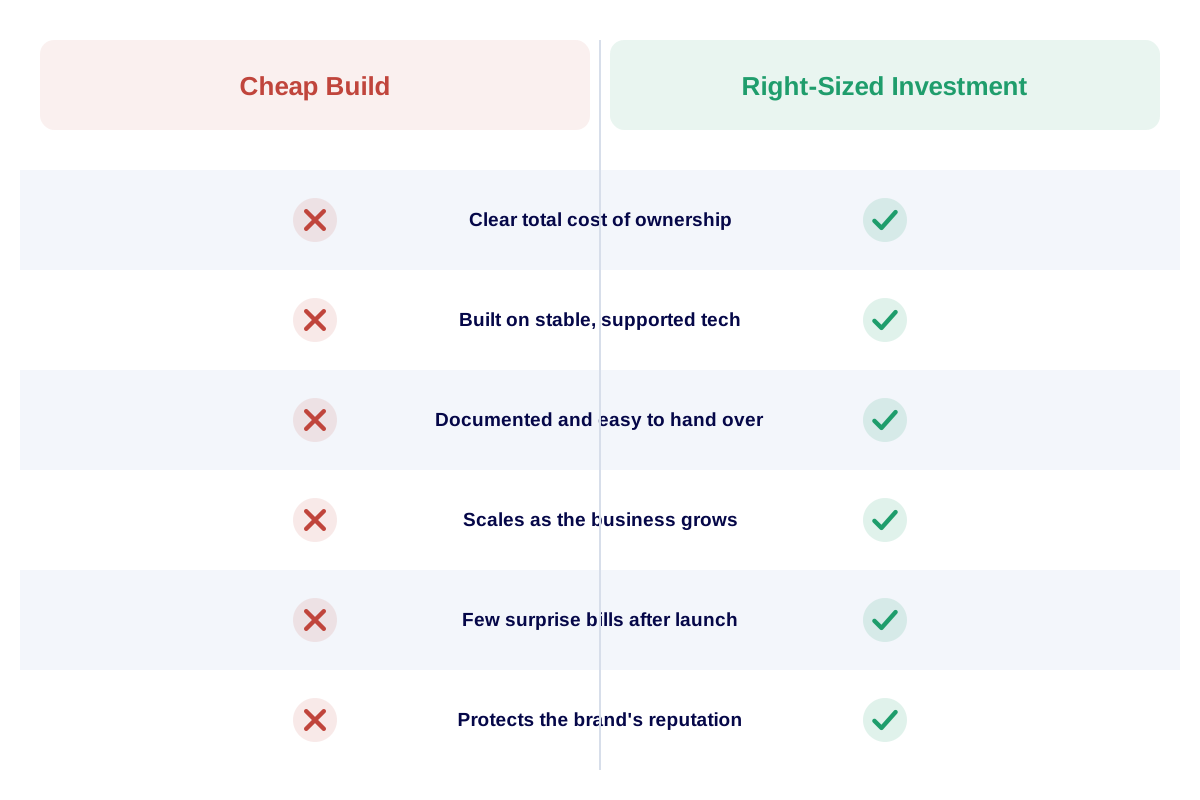
Total cost of ownership looks very different once hosting, security, SEO structure and eventual rebuilds are accounted for.
What Is Really Driving This Pattern
None of this happens because cheap developers are necessarily careless people. It happens because a price that is far below what a proper build requires simply cannot include everything a working, secure, visible website needs. Something has to be left out to hit that number, and it is rarely announced upfront which thing that will be. The business owner discovers the gap only once it causes a visible problem, by which point the original savings have usually already been spent several times over in fixes.
This is why comparing website costs purely on the initial quote is a bit like comparing cars purely on their sticker price without asking about fuel efficiency, service intervals or expected lifespan. The number on day one is real, but it is only one part of a much longer financial picture that most buyers never see until they are already living inside it.
An Illustrative Scenario (Not an Actual Client Case)
Consider a small logistics company that chooses the lowest of several website quotes to save money during a tight financial quarter. The site launches, looks reasonable, and the owner moves on to other priorities. Eighteen months later, a routine check by a new hire reveals the site is running on long-outdated software components, has no working backup, and has never ranked for any of the search terms potential clients actually use. Fixing the security gap, rebuilding proper SEO foundations and migrating to safer hosting ends up costing more than the original website did — and that is before accounting for how many enquiries likely never arrived during those eighteen months of poor visibility.
This is a composite, illustrative example rather than a specific client record, but it reflects a pattern seen often enough across small business websites to be worth taking seriously in advance.
What makes this pattern particularly costly is the sequencing. Security and visibility problems are usually discovered separately, months apart, each treated as its own isolated emergency rather than as symptoms of the same original decision. By the time all of them are fixed, the business has effectively paid for three or four smaller emergencies instead of one properly planned project, often at a higher combined cost and with more disruption along the way.

Practical Solutions and Recommendations
- Ask for the total cost of ownership, not just the build price: hosting, maintenance, and support terms.
- Confirm in writing whether basic security practices and SEO-ready structure are included by default.
- Request to see the vendor's other live websites and judge their speed and structure yourself.
- Budget for periodic maintenance and review from the outset, rather than treating the website as "done" after launch.
- Review your website's performance and security at least once a year, even if nothing seems obviously wrong.
A Total Cost of Ownership Checklist
- What is included in the build price, and what is billed separately later?
- Who is responsible for security updates after launch, and at what cost?
- Is the site built with SEO-ready structure, or will that need to be added afterward?
- What happens to the website if the vendor becomes unavailable?
- Is there a realistic plan for the website's next redesign, years from now, rather than treating it as permanent?
Being Honest About the Numbers
We are deliberately not attaching specific rupee figures to "how much a hidden cost typically turns out to be," because it depends entirely on the business, the extent of the shortcuts taken, and how long a problem goes unnoticed. What can be said honestly is that these costs tend to arrive unplanned, often at a less convenient time than the original purchase, and they are frequently larger in total than the amount originally saved. The best defence against this is simply asking better questions before paying anything, not after.
How to Identify the Right Long-Term Partner
A technology partner worth trusting with this decision will talk about your website's future, not just its launch day. They will be upfront about ongoing needs, offer realistic guidance on web design and website development scope, and, where relevant, apply the same standards to ecommerce development projects that carry even higher stakes around security and uptime. Transparency about what happens after launch is one of the clearest signals of a partner who is thinking about your total cost, not just their own next invoice.
Gravity Innovative Solutions has worked with businesses across Thrissur and Kerala for more than 13 years, and we would rather explain the real scope of a project honestly than win a quote comparison by leaving something important out. If you are currently weighing several quotes, we are happy to help you read between the lines of what each one actually includes before you decide.
Conclusion
The cheapest website development quote is not inherently a mistake, but it should never be evaluated on price alone. Ask what total cost of ownership looks like, not just what the first invoice says. That single shift in how you evaluate a quote is often the difference between a website that serves the business for years and one that quietly becomes an expensive problem within a year or two.
If you already have a website and are unsure which category it falls into, a short, honest technical and security review is usually enough to tell you. It is far better to find out now, on your own terms, than to find out later during an actual incident or a sudden drop in enquiries.
Your website should do more than simply exist online. It should build trust, attract the right audience and support your business goals.
If you would like an honest look at what a website project should really include before you commit to a quote, we are glad to help.
Related reading: Why Choosing the Cheapest Website Development Company Could Become Your Most Expensive Business Mistake and Is Your Website Mobile-Friendly, Fast and Ready for Today's Customers?