

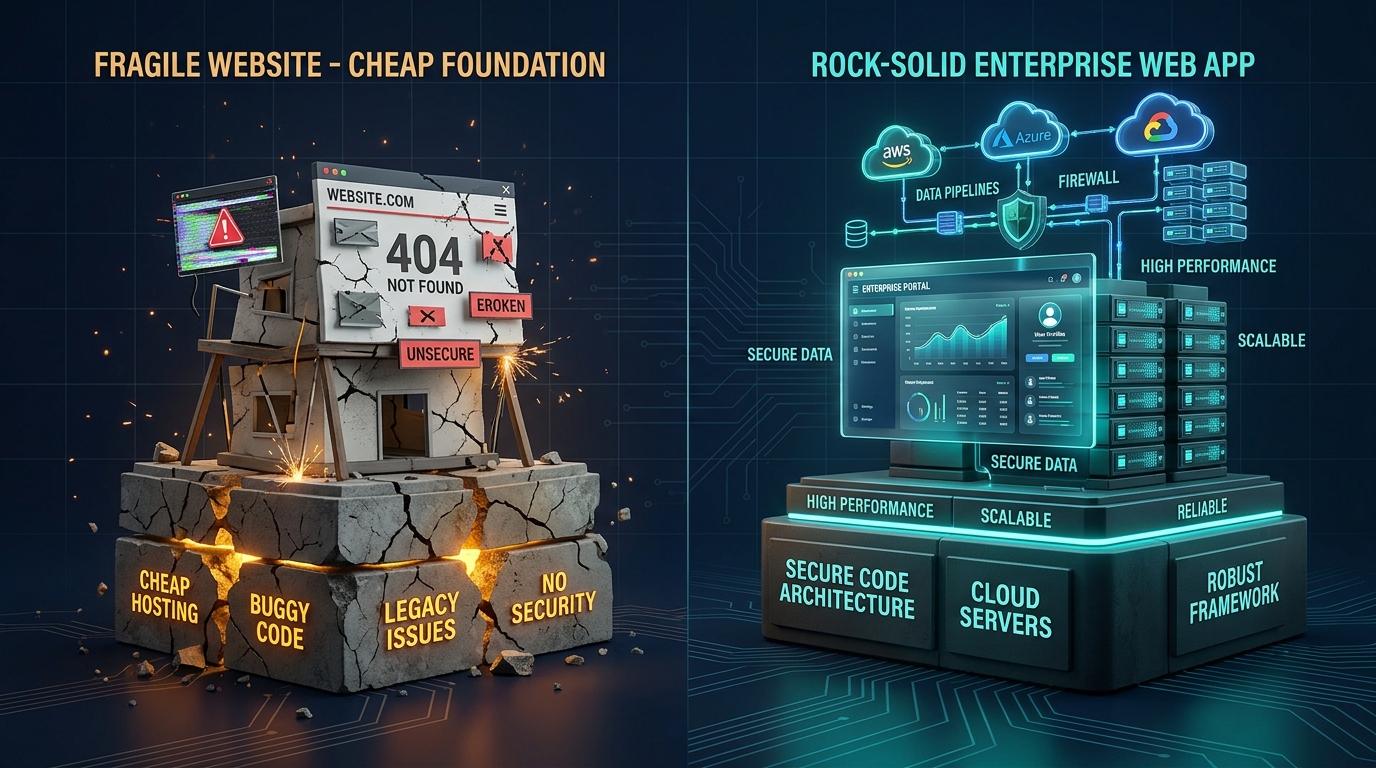
Every business owner who has ever asked three web developers for a quote knows the feeling. One number comes in dramatically lower than the rest, and suddenly the conversation in your head shifts from "who will build the best website for us" to "why pay more when this person will do it for so much less." It is a completely natural reaction. Money saved today feels real. Money that might be lost six months from now, because the site breaks, loads slowly, or simply fails to bring in enquiries, feels abstract and easy to discount.
That gap between what feels true in the moment and what turns out to be true later is exactly where the cheapest website development company usually does its damage. Not through dishonesty, necessarily, but through a price that was never going to cover everything a working business website actually needs.
Why This Decision Matters More Than It Looks
A website is rarely just a cost centre. For most small and mid-sized businesses in Kerala, it is the first contact point for a new customer, the place that confirms whether a company is legitimate, and often the only "salesperson" working around the clock without a break. When that salesperson is built on the cheapest possible foundation, the damage does not show up as a single dramatic failure. It shows up slowly: a few extra seconds of load time here, a form that quietly fails to send on some phones, a design that looks fine on a laptop but collapses on a mid-range Android screen.
None of that necessarily feels urgent in month one. By month six or twelve, though, it has quietly cost the business enquiries it never knew it was losing.

Common Mistakes Business Owners Make When Choosing on Price Alone
1. Comparing numbers without comparing scope
A quote of ₹15,000 and a quote of ₹60,000 are not automatically the "same website at different prices." They are frequently two entirely different products. The cheaper one might exclude mobile testing, SEO-ready structure, image optimisation, or any support after launch. Without a like-for-like scope comparison, the business owner is not really choosing the cheaper option — they are choosing the option with less written down.
2. Assuming "a website is a website"
To a non-technical buyer, most finished websites look fairly similar on the surface: a homepage, some photos, a contact form. What is invisible is the code underneath, how the images were compressed, whether the layout is actually responsive or just "shrinks" awkwardly on a phone, and whether anything was tested at all before going live.
3. Treating the website as a one-time purchase
A website is closer to a vehicle than a piece of furniture. It needs occasional maintenance, security patching and small updates. A rock-bottom quote rarely includes any of this, which means the "cheap" website often comes with an unplanned second bill the moment something needs fixing.
4. Not asking who actually owns the files
Some low-cost builds are delivered on a locked platform or template that the vendor controls, not the business. If that vendor becomes unresponsive, the business owner can be left unable to make even a simple text change without starting over.
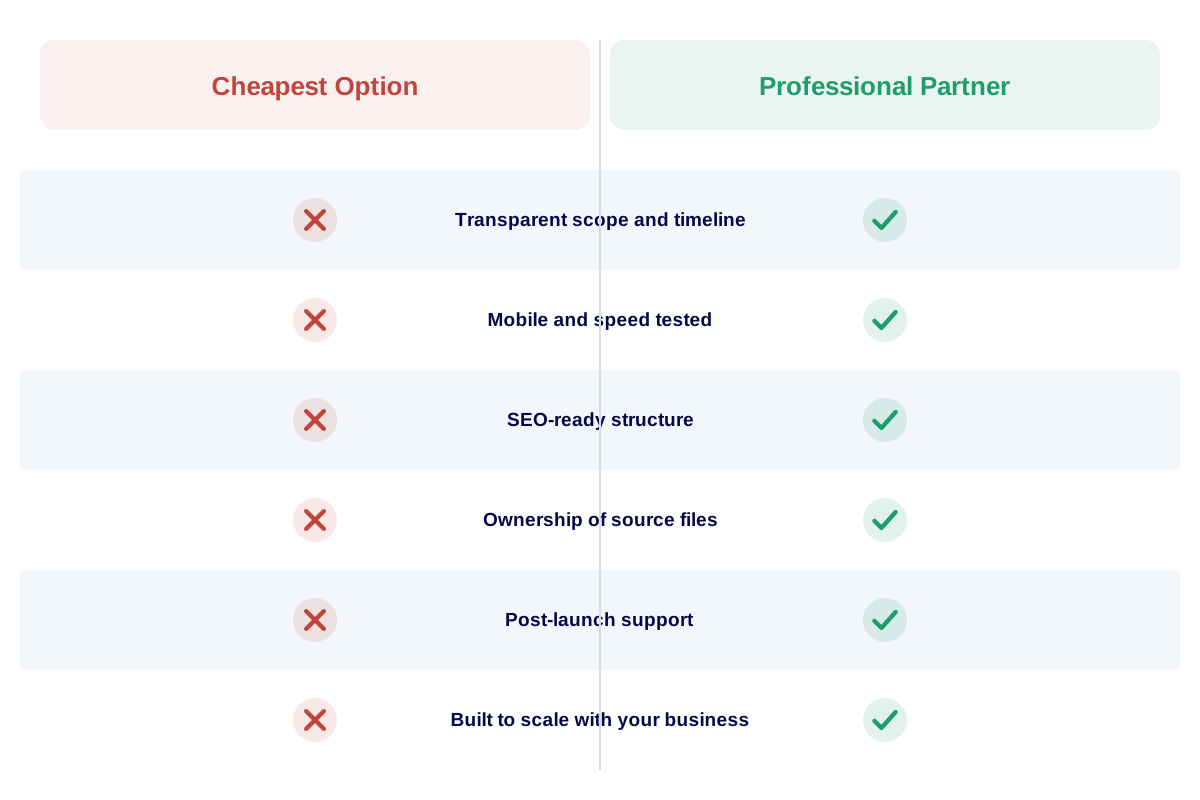
A side-by-side look at what typically separates a rock-bottom quote from a professionally scoped build.
What Is Actually Happening Underneath a Rock-Bottom Quote
There is a simple reason extremely low website quotes exist: building a genuinely tested, secure, SEO-ready, mobile-responsive website takes real hours of planning, design, development, testing and quality checking. When the price is pushed far below what those hours would reasonably cost, something in that list has to be skipped. It is rarely announced. It is simply absent.
It also helps to understand the business model on the other side of a very low quote. A developer or agency surviving on extremely thin margins usually needs high volume to stay afloat, which means limited time per project. Less time per project almost always means less testing, less customisation and less attention once the invoice is paid. This is not a moral failing on the vendor's part; it is simple arithmetic. A buyer who understands that arithmetic is in a far better position to judge what a given price can and cannot realistically deliver.
In practice, this usually plays out as one or more of the following: a generic template reused across many clients with minimal customisation, no real testing across different phones and browsers, copied or thin content that search engines do not reward, and no plan for what happens if the site needs a fix after launch. Individually, each shortcut might seem minor. Together, they decide whether the website actually helps the business or quietly works against it.
An Illustrative Scenario (Not an Actual Client Case)
Picture a Thrissur-based furniture retailer expanding from a single showroom into online enquiries. They choose the lowest of three quotes, reasoning that "a website is a website" and the money saved can go toward opening stock. The site goes live quickly, looks acceptable on a desktop monitor, and the owner is satisfied.
Three months later, a staff member notices something odd: almost no enquiries are coming from the website, despite steady social media activity sending people to it. A closer look reveals the contact form silently fails on most Android phones, the homepage takes close to ten seconds to load over mobile data, and the site has no meaningful SEO structure, so it barely appears in local search results at all. By the time this is diagnosed, several months of potential enquiries have simply never arrived — not because customers did not exist, but because the website never gave them a working way to act.
This kind of scenario is illustrative, not a specific client story, but it reflects a pattern that is common enough across small business websites to be worth taking seriously before signing a contract, not after.
Why Businesses Still Choose the Cheapest Option, and When That Is Reasonable
It would be unfair to suggest that choosing a lower-priced website is always a mistake. A genuinely early-stage startup testing an idea, a small side business that just needs a basic online presence, or an organisation with a short-term, narrow need may be entirely well served by a simple, inexpensive site. The problem is not low price itself. The problem is low price paired with high expectations — wanting a lead-generating, search-visible, mobile-perfect business tool at a price that was only ever going to cover a bare-minimum online brochure.
Before comparing quotes, it helps to be honest with yourself about which category your business actually falls into. A simple presence and a serious growth tool are different projects with different realistic price ranges, and no amount of negotiation changes that underlying reality.
Practical Solutions and Recommendations
None of this means the most expensive quote wins by default, or that budget-conscious businesses cannot get a solid website. It means price should be evaluated against scope, not in isolation. A sensible approach looks like this:
- Ask every vendor for a written breakdown of exactly what is included, not just a final figure.
- Request examples of live websites they have actually built, and open them on your own phone.
- Confirm who owns the source files, the domain and the hosting account once the project is delivered.
- Ask directly what happens if something breaks a month after launch, and get the answer in writing.
- Check whether basic SEO structure and mobile responsiveness are included by default, not sold as "extras" later.
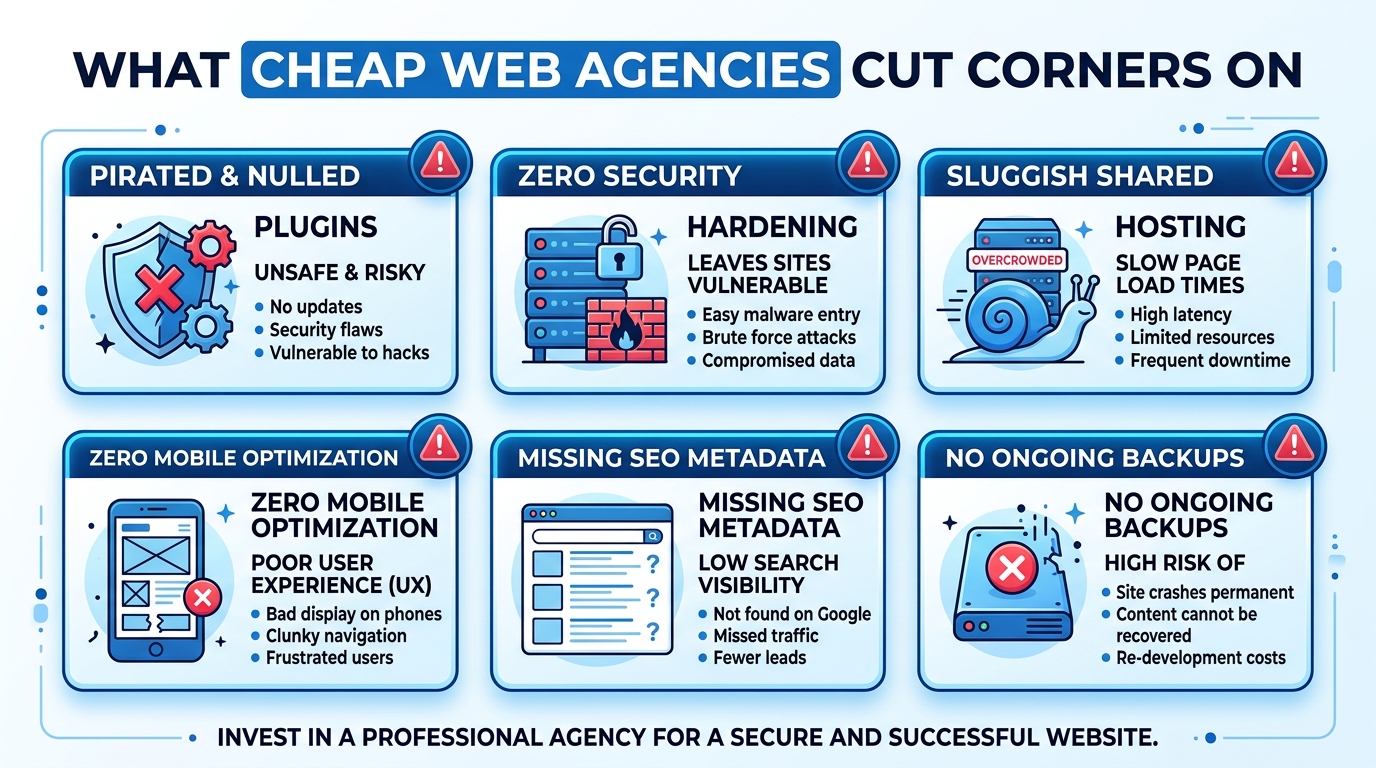
A Simple Evaluation Checklist Before You Sign
Before committing to any website development company, cheap or otherwise, run through this short checklist:
- Is the scope of work described in writing, page by page?
- Does the quote mention mobile testing specifically, not just "responsive design" as a buzzword?
- Is there a named point of contact for support after launch, and for how long?
- Will you receive full ownership of the website files and admin access?
- Does the vendor have other live websites you can actually test on your own device?
- Is there clarity on hosting, domain renewal and who is responsible for each?
The Real Cost and Risk Behind a "Cheap" Website
It is worth being honest about what cannot be known in advance: exact figures for lost enquiries, rebuild costs, or downtime vary by business and are not something we will invent here. What can be said with confidence, based on how these situations typically unfold, is the shape of the risk: a business that underpays for its website upfront often pays again later — through a rebuild, through lost visibility in search results, through customers who bounce off a slow page, or through staff time spent trying to fix something nobody fully understands. The real comparison is not "cheap versus expensive." It is "pay once, properly" versus "pay twice, the second time under pressure."
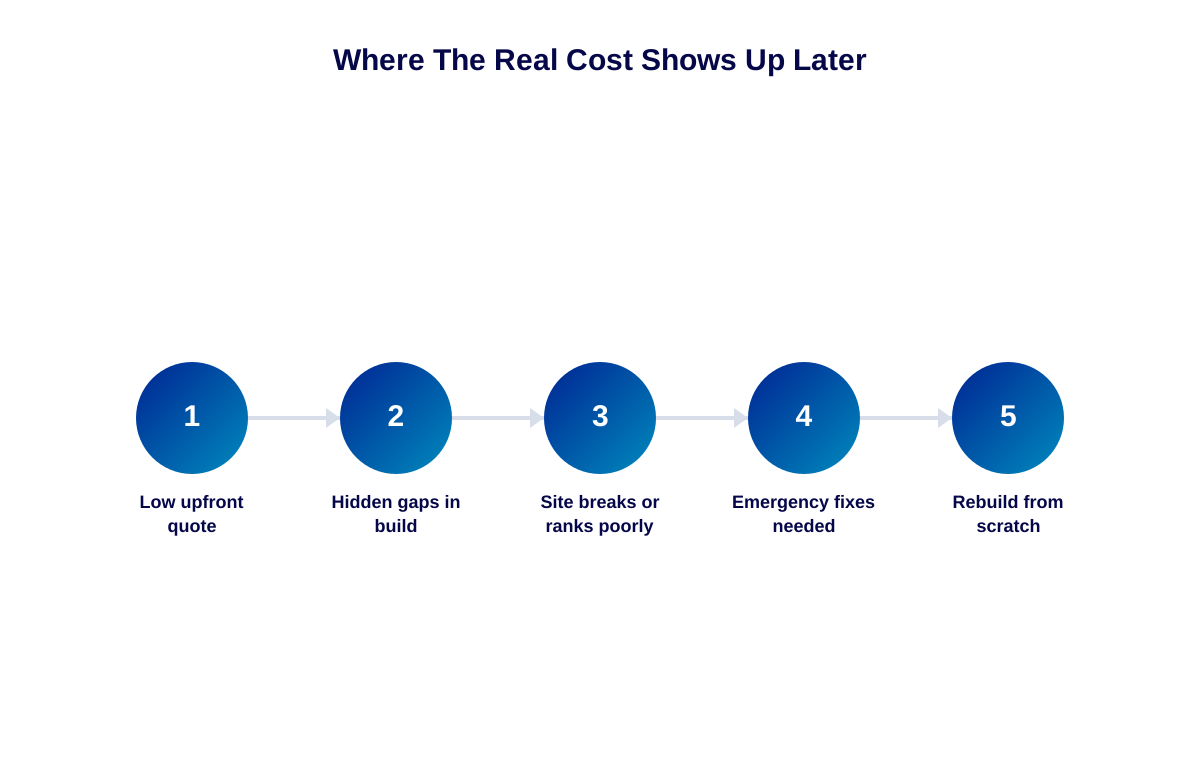
The real comparison is not "cheap versus expensive." It is "pay once, properly" versus "pay twice, the second time under pressure."

How to Identify the Right Technology Partner
A trustworthy website partner is usually easy to spot once you know what to look for: they ask questions about your business before quoting a number, they can explain their process in plain language, they show you real, working examples rather than just screenshots, and they are upfront about what is and is not included. If a company specialises in responsive, SEO-ready web design, builds on a proper custom web development foundation rather than a locked template, and is transparent about ongoing support, that combination is a far more reliable signal than the number on the quote alone.
At Gravity Innovative Solutions, we have been building websites and digital solutions for businesses in Thrissur and across Kerala for more than 13 years. We do not claim to be the cheapest option in every comparison, and we would rather lose a price-only comparison than deliver a website that quietly under-serves a client six months down the line. If budget is genuinely tight, say so early in the conversation — a good partner will help prioritise what matters most for your stage of business rather than quietly cutting corners you were never told about.
Conclusion
Choosing a website development company is not really a one-time spending decision — it is a decision about how your business will present itself online for years to come. The cheapest quote is not automatically the wrong choice, but it deserves the same scrutiny as the most expensive one. Ask what is included, ask who owns the result, and ask what happens after launch. Those three questions alone will filter out most of the risk long before a contract is signed.
Your website should do more than simply exist online. It should build trust, attract the right audience and support your business goals.
If you are comparing quotes right now and want a second opinion on what should realistically be included, we are happy to talk it through with no pressure attached.
Related reading: The Hidden Cost of Cheap Website Development and Does Your Website Look Professional Enough to Earn Customer Trust?