

A gym owner in Thrissur did everything by the book. He invested in SEO for over a year, watched his website traffic steadily climb in Analytics, and genuinely had reason to feel good about it. Then he looked at new membership sign-ups for the same period and found they'd barely moved. More people were visiting his website every month. Almost none of them were becoming members. That gap, between rising traffic and flat results, is one of the most confusing and frustrating experiences a business owner can have with digital marketing, mostly because it looks like the opposite of a problem on the surface.
It's natural to assume that if traffic is growing, everything downstream should grow with it. But a website is not a single machine with one dial. It's a sequence of moments, each of which can quietly break without anyone noticing, and SEO only controls the first part of that sequence: getting someone to click through from a search result. What happens after that click is a different job entirely, with its own set of common failures.
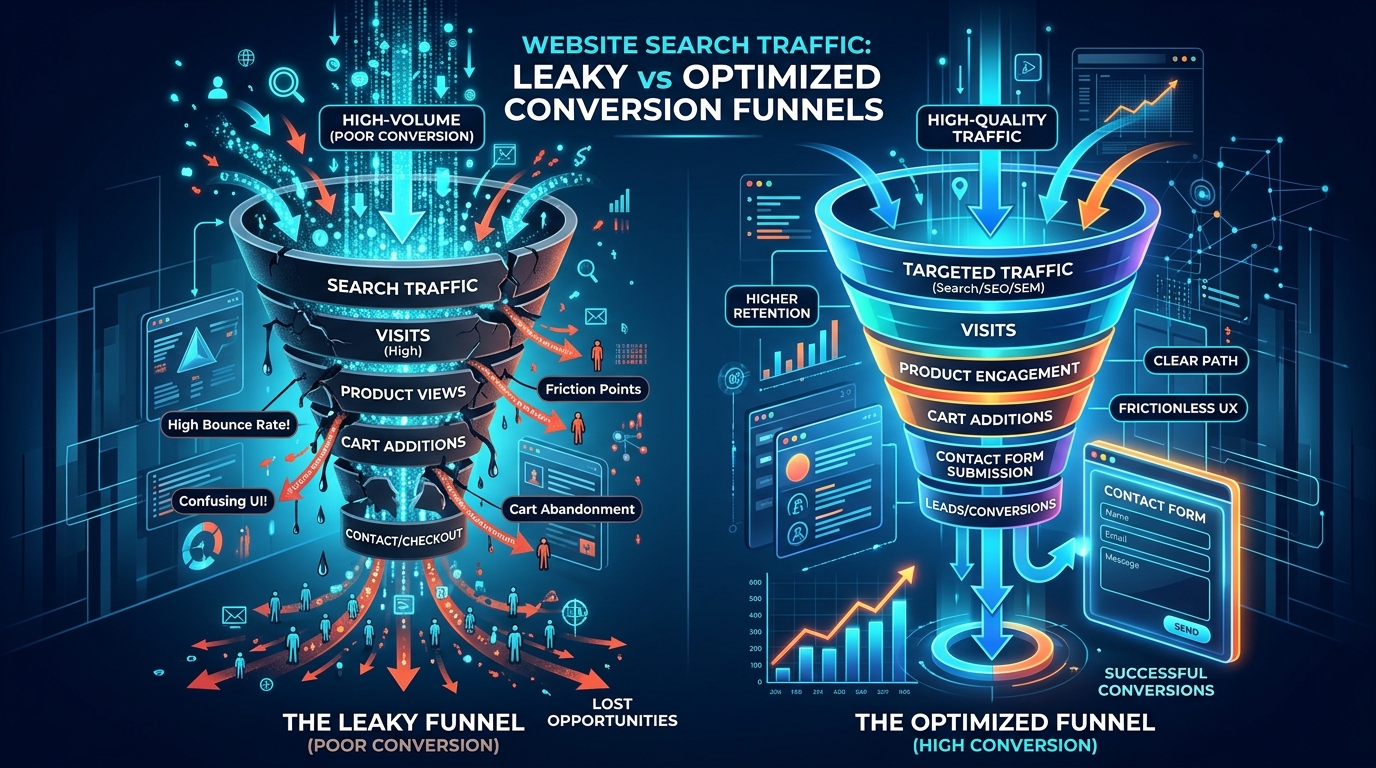
Two lines that should move together, quietly drifting apart.
Why This Gap Matters So Much
Rising traffic with flat leads is, in some ways, a more expensive problem than not ranking at all. At least when you're invisible on Google, the issue is obvious and the fix is clear: get found. When you are being found and still not converting, the business impact is just as real, but the cause is far less obvious, and it's easy to misdiagnose. Many business owners in this situation wrongly conclude that "SEO doesn't work for my industry," when the actual issue has nothing to do with search visibility at all.
This misdiagnosis carries its own cost. Businesses sometimes cut SEO spend entirely in frustration, right at the point where the groundwork is finally paying off in visibility, instead of fixing the much smaller, much cheaper problem sitting on the website itself.
There's also a quieter opportunity cost worth naming. Every visitor who arrives genuinely interested and then leaves without taking any action isn't a neutral event. In many cases, that same person doesn't come back later on their own, and doesn't bother checking page two of Google for an alternative either — they simply search again with slightly different wording and land on whichever competitor's page does make the next step obvious. The SEO work successfully won their attention. The website then handed that attention to someone else almost immediately.
Common Mistakes That Create This Gap
In practically every case we've seen, the disconnect traces back to one or more of a short list of causes.
- Treating SEO and website experience as separate projects. Visibility and conversion are frequently handled by different people, or different vendors, who rarely talk to each other about how the two connect.
- No clear call to action on key pages. A visitor who arrives interested but isn't told clearly what to do next — call, enquire, book a visit — will often simply leave.
- Ranking for the wrong kind of search intent. Content written to attract general informational searches can bring plenty of visitors who were never close to buying in the first place.
- A contact process that creates friction. Long forms, broken mobile layouts, or a WhatsApp link that doesn't open properly can quietly cost real enquiries.
- Weak or missing trust signals. No reviews, no clear proof of credibility, no reason for a new visitor to believe this is a business worth contacting today rather than "maybe later."
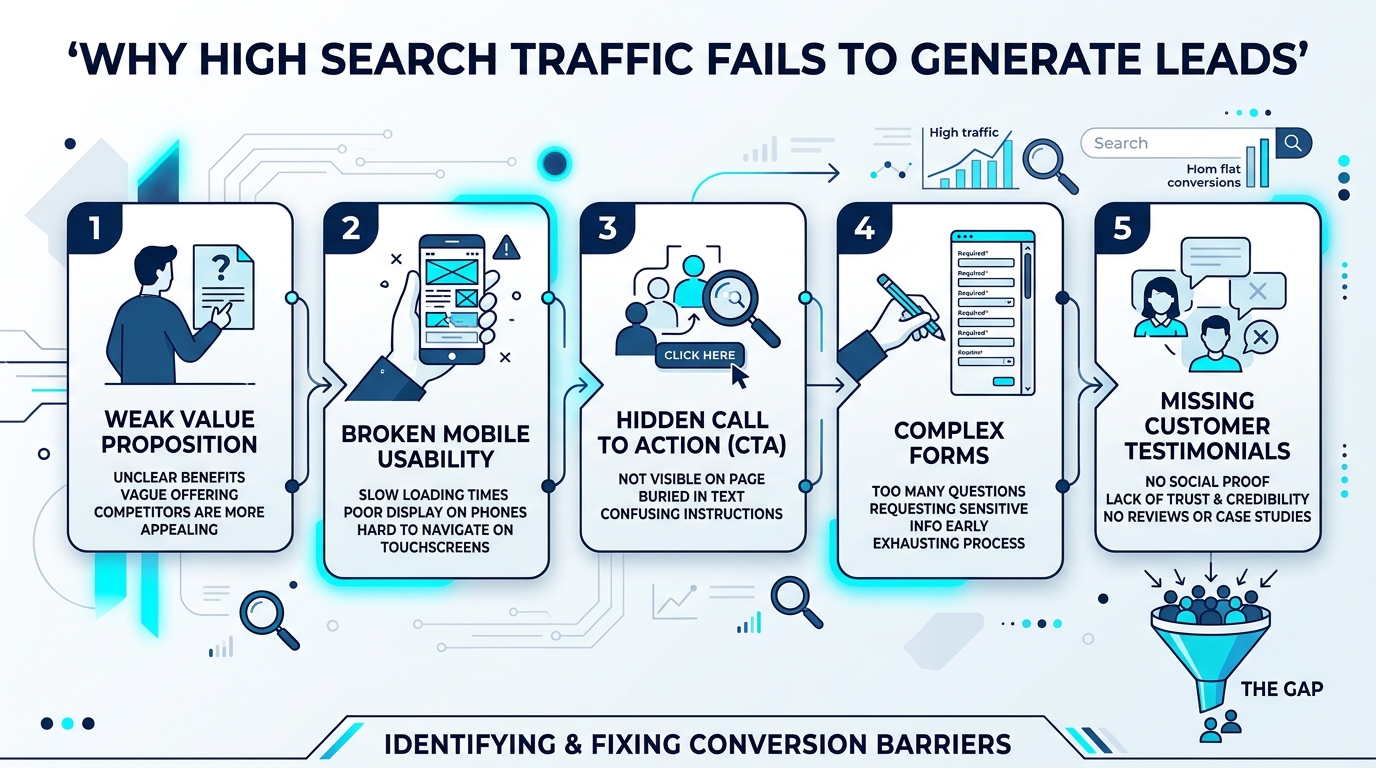
Worth working through methodically once rankings and traffic are no longer the obvious bottleneck.
Why This Gets Missed for So Long
Part of the reason this gap persists is that the two halves of the problem are usually reported separately, if they're reported at all. An SEO report shows rankings and traffic climbing, which looks like success. A sales or enquiries log, kept somewhere else entirely, perhaps in someone's head rather than a spreadsheet, shows a flatter picture. Nobody is deliberately hiding anything. The two numbers simply never sit next to each other on the same page, so the disconnect between them goes unnoticed far longer than it should.
It also gets missed because business owners, understandably, check their own website far less often than potential customers do. A form that's been quietly broken for three months, or a WhatsApp button pointing to an old number, can go completely unnoticed by the business while actively turning away every single visitor who tries to use it.
The Journey a Visitor Actually Takes
It helps to break the path from search to enquiry into distinct steps, because each step is a place things can quietly go wrong, independent of how well your SEO is performing.
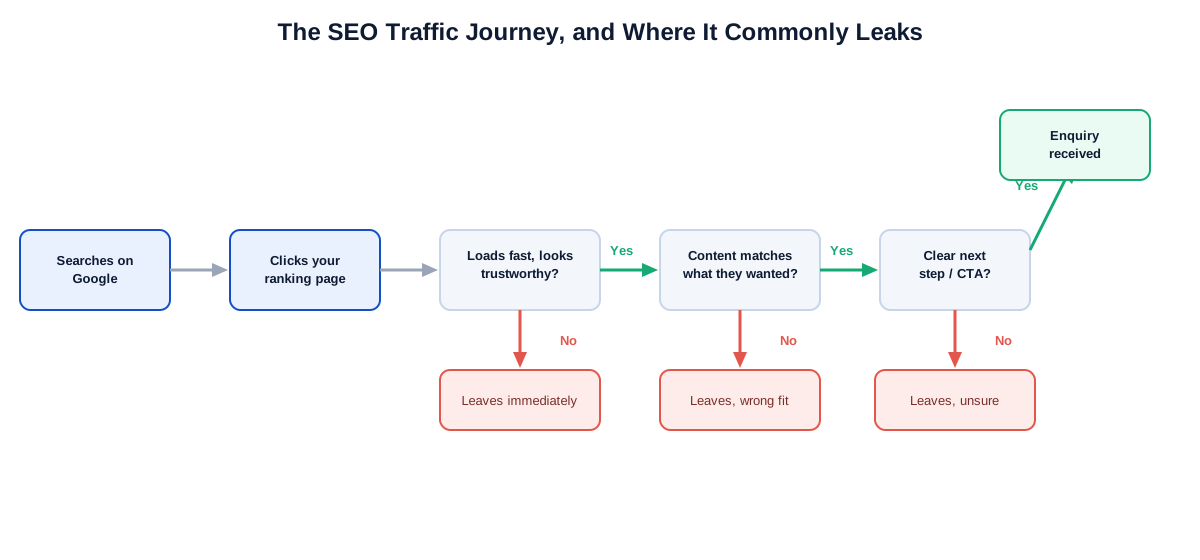
SEO gets a visitor to the second box. Everything after that depends on the website itself.
An Illustrative Scenario
Take a mid-sized interior design firm — illustrative, not a specific client — whose SEO work successfully grew organic traffic by a meaningful margin over a year. Enquiries, however, barely moved. A closer look revealed the culprit: their most visited page, a blog post about design styles, had no contact information, no enquiry form and no link to their portfolio anywhere near the top of the page. Visitors were genuinely interested, genuinely in the target audience, and had absolutely no obvious next step once they finished reading. The content was doing its job attracting attention. Nothing after it was doing its job turning that attention into a lead.
A second scenario: a home appliance repair service noticed steady traffic growth but equally flat enquiries, until they tested their own contact form from a mobile phone and discovered it simply failed to submit on several common phone browsers. Nobody on their team had tested this in over a year, because nobody on their team used that specific browser configuration themselves. The fix took an afternoon. The unnoticed problem had likely been running for months.
Traffic enters the funnel in good numbers. The leaks happen quietly, well before the bottom.
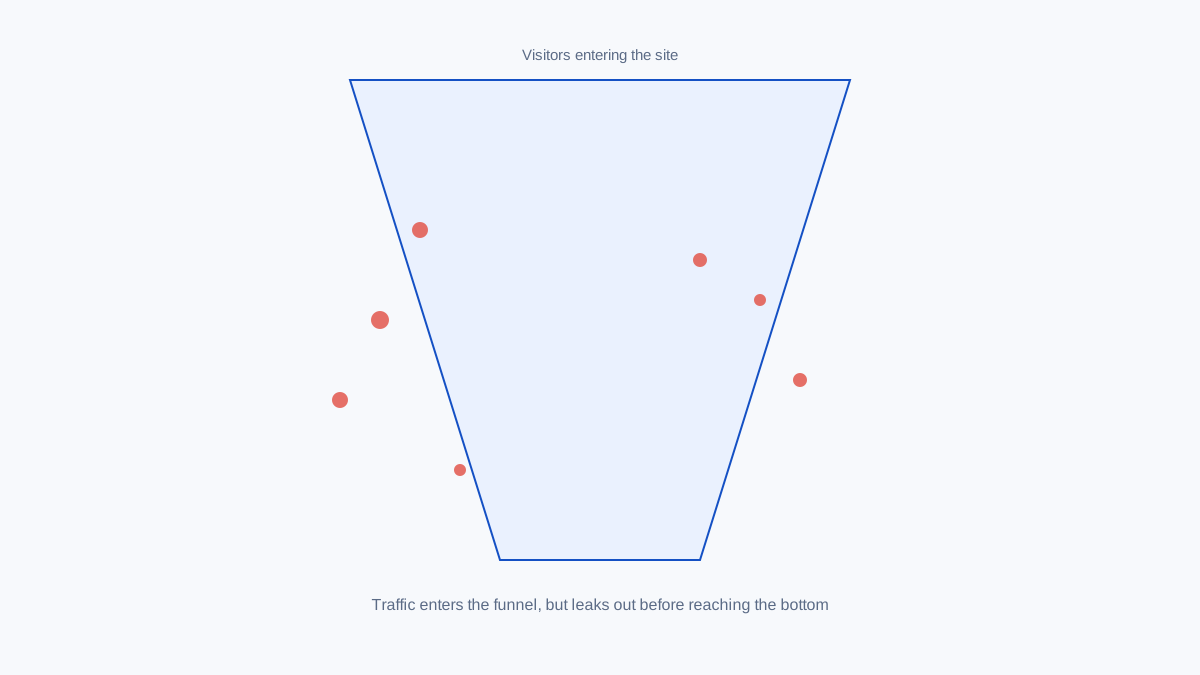
A page nobody can find is a visibility problem. A page nobody acts on is a design problem, and just as costly.
Ranking Well vs. Converting Well
These are two genuinely different outcomes, measured differently, and achieved through different work. Confusing them is where most of this frustration comes from.
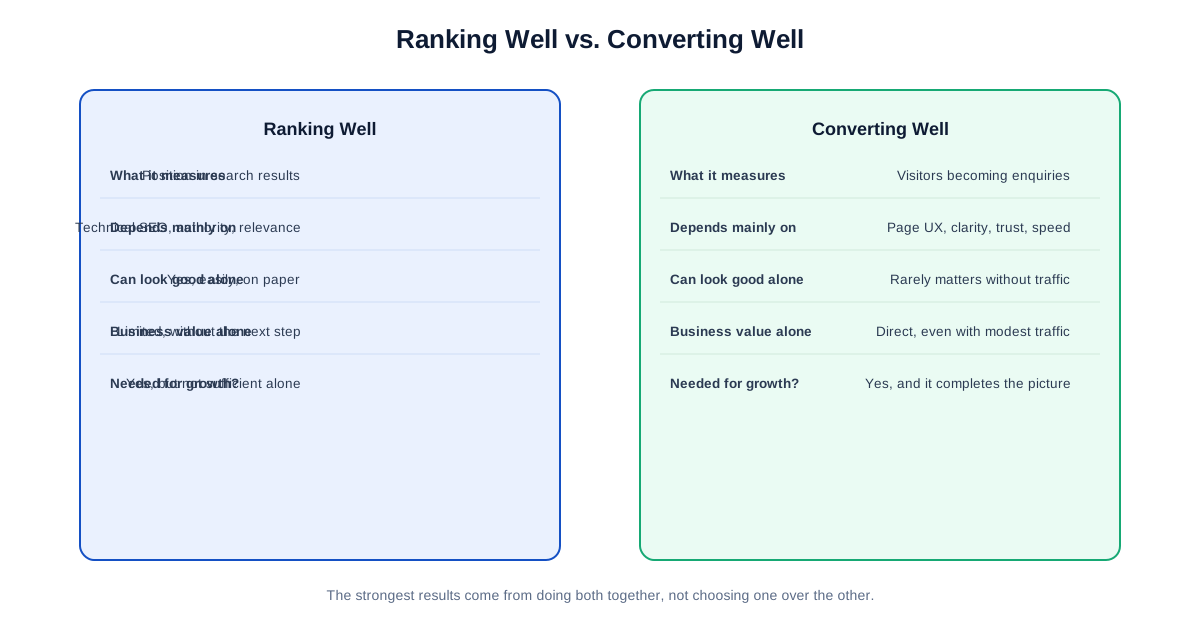
Neither one replaces the other. Strong results need both working together.
Practical Solutions and Recommendations
Fixing this gap rarely requires starting over. It requires a focused review of the specific moments where visitors are likely dropping off.
- Add a clear, visible call to action on every important page — not just the homepage.
- Test your own contact form and WhatsApp links on an actual mobile phone, not just a desktop browser.
- Review your top-ranking pages and honestly assess whether the content matches genuine buying intent or just general interest.
- Add visible trust signals — reviews, certifications, real photos of your work or premises — near key decision points.
- Check your mobile page speed, since slow loading is one of the most common silent causes of lost conversions.
- Confirm your enquiry tracking actually works, so you're measuring real leads, not just estimating them.
This is exactly where website design and SEO need to work together rather than as separate, disconnected efforts, often as part of a broader digital marketing strategy that keeps visibility and conversion aligned instead of optimising one while quietly neglecting the other.
A Step-by-Step Evaluation Checklist
- List your five highest-traffic pages from Analytics and open each one as if you were a first-time visitor.
- On each page, time how long it takes to find a way to contact you. If it's more than a few seconds, that's a problem.
- Submit your own contact form on both desktop and mobile to confirm it actually works end to end.
- Compare the keywords driving traffic to those pages against what a ready-to-buy customer would actually search.
- Check whether reviews, credentials or proof points are visible near your main calls to action.
- Cross-check reported leads against your actual phone, WhatsApp and email enquiry records for the same period.
Weighing the Cost and the Risk
It's reasonable to want a number for how much this gap is costing, but that figure depends entirely on your traffic volume, average deal value and how long the disconnect has existed. Rather than inventing a statistic, use your own Analytics to estimate how many additional enquiries a modest improvement in conversion rate would realistically produce at your current traffic level, and treat that as your working business case for fixing it.
It's also worth noting what this problem does not require: an expensive website rebuild, in most cases. The fixes involved — a clearer call to action, a tested contact form, a faster-loading image, a review section moved higher on the page — are frequently small, targeted changes rather than a full redesign. Treating this as a quick diagnostic and repair job, rather than assuming the entire site needs to be rebuilt from scratch, usually keeps both the cost and the disruption manageable.
How to Identify the Right Partner for This Work
Because this problem sits at the intersection of SEO and website design, the right partner needs to understand both, and be willing to look honestly at your site rather than simply pointing at the SEO numbers as proof that "the work is done." A useful early test during any evaluation is simply asking a prospective partner to walk through your website live, on a call, and point out where they think visitors are most likely dropping off. A partner who treats this as an easy, interesting question tends to be the kind who's actually looked at real websites with real conversion problems before, rather than one who only ever looks at ranking dashboards.
Gravity Innovative Solutions has handled both sides of this for businesses across Thrissur and Kerala for over 13 years, which is precisely why we treat visibility and conversion as one connected outcome rather than two separate invoices.
Conclusion
Growing traffic is genuine progress, and it's worth recognising as such rather than dismissing the SEO work that produced it. But traffic was always meant to be a means to an end, not the end itself. Your website should do more than simply exist online. It should build trust, attract the right audience and support your business goals, all the way through to the enquiry actually landing in your inbox.
Related reading: if you suspect the opposite problem — not enough visibility in the first place — see How Much Business Are You Losing Because Your Website Is Not Ranking on Google?