

A clinic owner in Thrissur once told us she wasn't worried about her website because "people who need us always find us somehow." A few weeks later, while helping her review analytics for an unrelated reason, we searched Google for the exact phrase a new patient would use — a service name plus the area she operates in. Her clinic wasn't on the first page. Three competitors were, including one that had opened barely a year earlier. She hadn't lost those patients to a better clinic. She had lost them to a better search result.
That is the uncomfortable part of not ranking on Google: you rarely see the business you lose. There's no invoice for it, no rejection email, no missed call that says "we chose someone else because we couldn't find you." The enquiry simply never reaches you, and from where you sit, everything looks calm. Quiet isn't always a sign that things are fine. Sometimes it's a sign that demand is going somewhere else entirely.

When a website doesn't appear in search results, the demand behind that search doesn't disappear — it moves to whoever Google shows instead.
Why This Problem Matters More Than Most Owners Realise
It's well established that most people searching on Google engage with only the first handful of results they see, and very rarely go looking for a business on the second page or beyond. That's not a Gravity statistic, it's simply how search behaviour has worked for years and continues to work. If your business isn't somewhere in that first visible set of results for the terms your customers actually use, you aren't just missing a little bit of traffic. You are, for practical purposes, invisible to anyone who doesn't already know your name.
That distinction matters because a search result isn't like a billboard that a passerby might or might not notice. Someone searching "wedding caterer Thrissur" or "industrial pump supplier Kerala" has already decided they need that service — they're actively looking to spend money. Missing that moment is different from missing a casual glance at an advertisement. It's missing a customer who was ready.
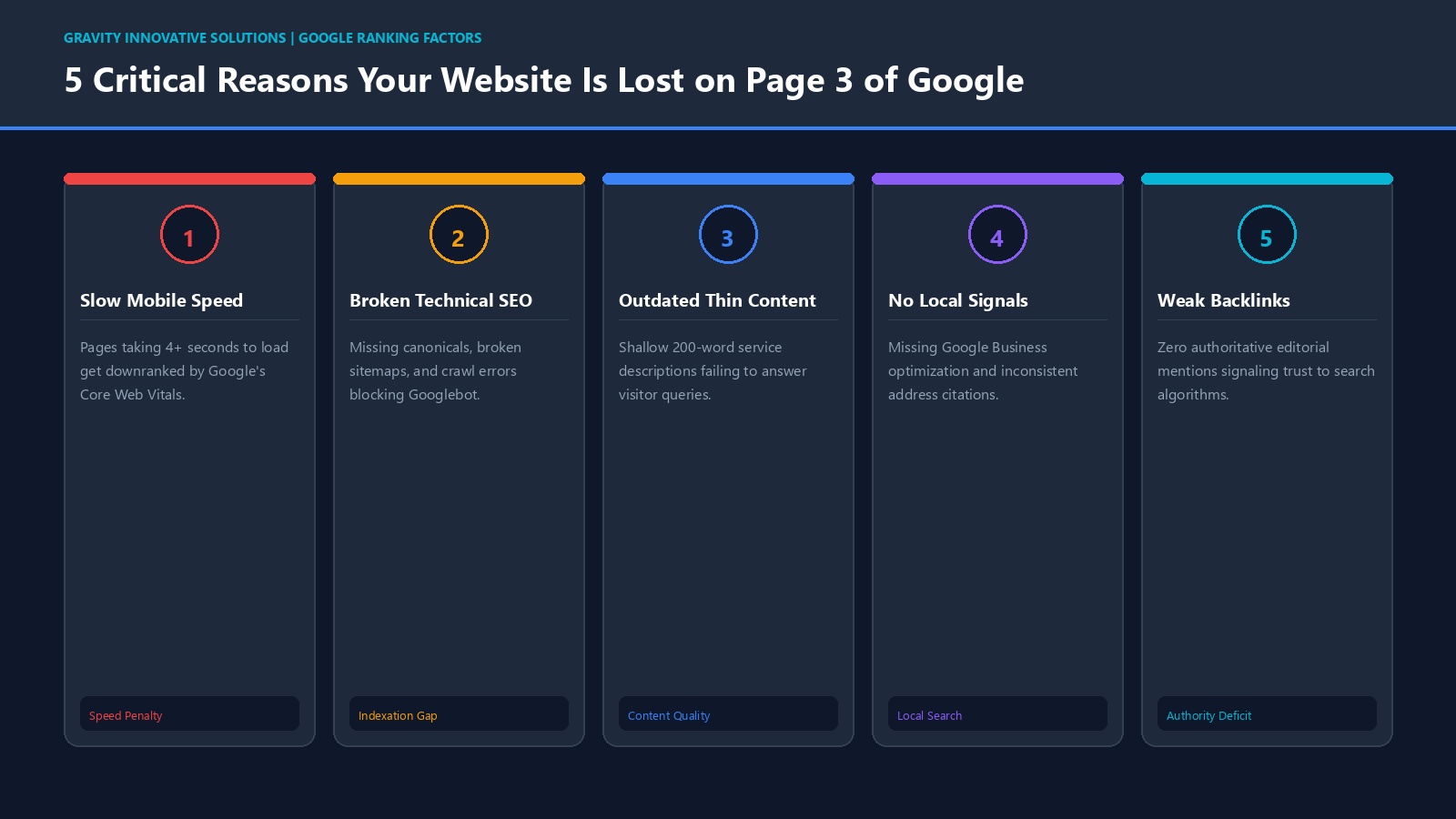
A general, well-documented pattern in search behaviour — not a measured figure for any specific business.
Page One vs. Page Two: The Practical Difference
It helps to think of Google rankings less as a vanity metric and more as shelf space. A shop on the main road with a clear signboard gets a different kind of footfall than one tucked behind three other lanes with no signage, even if the second shop sells exactly the same product, at the same price, with the same quality. Ranking position works similarly online.
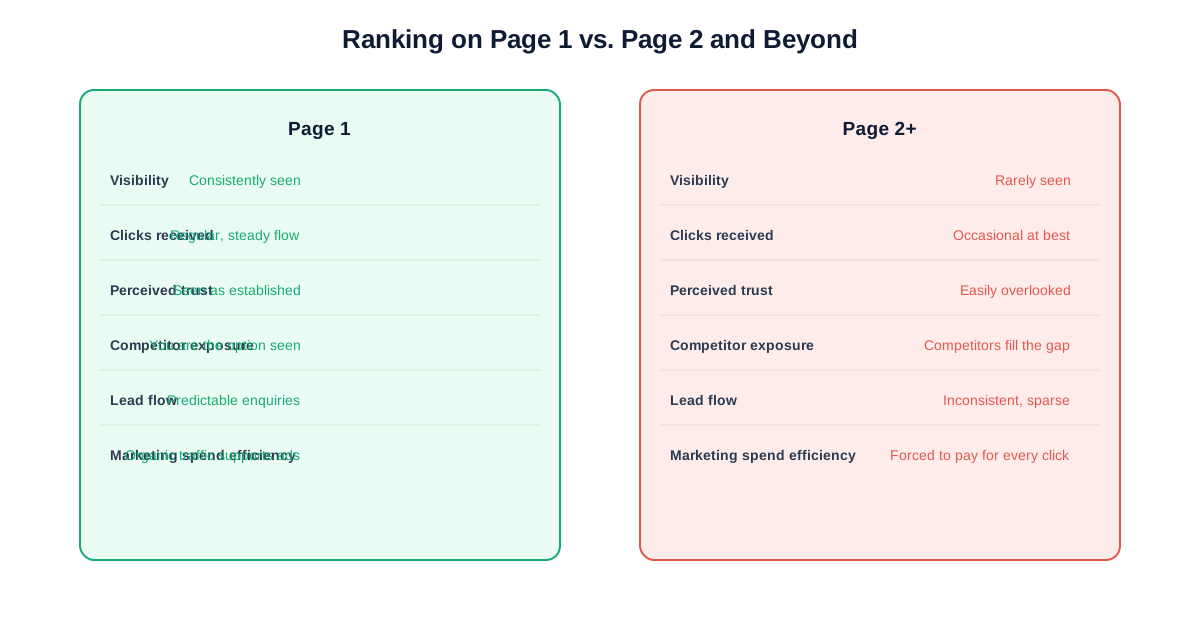
The practical difference between ranking on page one and ranking anywhere beyond it.
The Quiet Cost Businesses Underestimate
The direct cost of not ranking is obvious once you say it out loud: fewer enquiries, fewer sales. But there are second-order costs that tend to go unnoticed for far longer.
- You end up paying more for Google Ads or other paid channels to manufacture the visibility that organic rankings would have given you for free, every single month, with no option to stop paying without the traffic disappearing too.
- Customers who do recognise your brand name may still search for you before calling, and if a competitor dominates that search instead, your own brand search can end up sending business to someone else.
- A business that's hard to find online can quietly read as outdated or inactive to a generation of customers who check Google before they check anything else, even when the business itself is thriving offline.
- The problem compounds. A competitor who ranks well today accumulates more reviews, more backlinks and more content over time, which tends to make the gap wider the longer it's left unaddressed.
Lost visibility rarely announces itself — it shows up later, as revenue that quietly stopped arriving.
Common Mistakes That Keep Businesses Off Page One
In our experience working with businesses across Thrissur and Kerala, the same handful of mistakes come up again and again:
- Treating the website as a one-time project. A site that was built, launched and then left untouched for years rarely keeps pace with how competitors and search engines evolve.
- Ignoring technical health. Slow loading pages, poor mobile experience, broken links and weak site structure all make it harder for Google to crawl, understand and favourably rank a site, regardless of how good the business itself is.
- Publishing content that doesn't match real search intent. Many websites talk about the business the way the owner thinks about it, rather than the way a customer actually searches for it.
- Neglecting the Google Business Profile. For most local businesses, this free listing is one of the highest-impact things to get right, and it's frequently left incomplete, unverified, or unanswered when customers leave reviews or ask questions.
- No consistent authority building. Rankings respond to trust signals built over time — credible mentions, backlinks, directory listings and reviews — not a single burst of effort.
- Not tracking anything. Without checking Search Console, Analytics or even basic incognito searches regularly, a ranking decline can go unnoticed for months before anyone realises enquiries have slowed down.
What's Actually Happening Behind a "Not Ranking" Website
When a website doesn't rank, it's rarely down to one single cause. Google's ranking systems weigh a combination of factors in plain terms: can the site be crawled and indexed properly; does its content genuinely match what the searcher is looking for; does the site carry enough trust and authority signals compared to competing results; and does it offer a decent experience once someone actually lands on it. A weakness in any one of these can hold a site back even if the others are strong.
This is also where the real business impact becomes visible — not as an abstract ranking number, but as a path a potential customer actually walks.
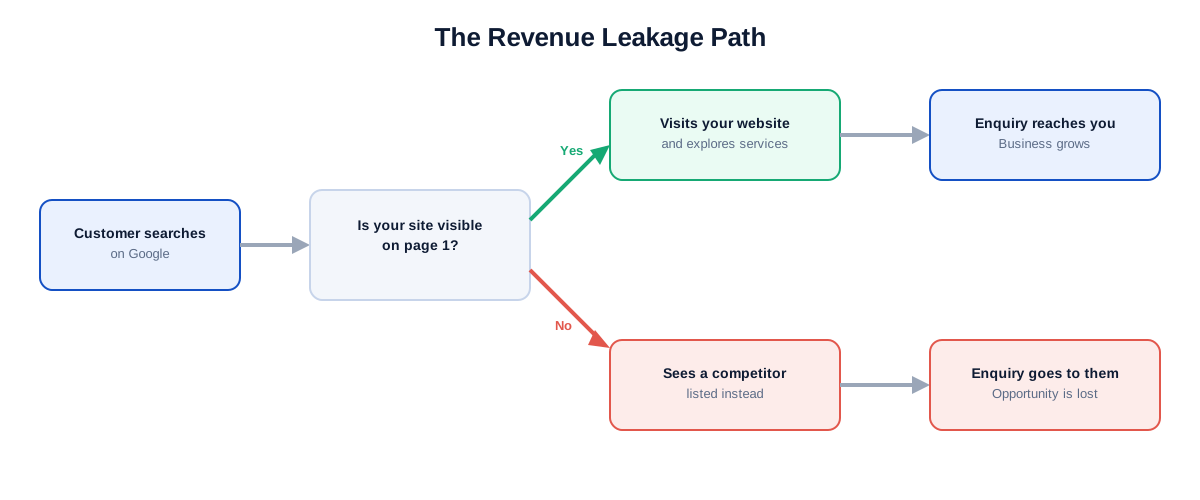
The same search, two very different outcomes, depending entirely on whether your website is visible at the moment it matters.
An Illustrative Scenario
Consider a furniture showroom in Thrissur — this is an illustrative example, not a specific client story. The owner is confident business is "steady," based on footfall from the physical store and occasional word-of-mouth. What he doesn't see is that for a search like "modular kitchen Thrissur," his showroom doesn't appear anywhere in the first several results, while two newer competitors do, with Google Business Profiles full of recent photos and reviews. He isn't short on quality or price competitiveness. He's short on visibility at the exact moment someone is deciding who to call. Over a year, that gap doesn't show up as a single lost sale he can point to — it shows up as a showroom that feels slightly quieter than it should, for reasons that are hard to pin down without actually looking.
A second, equally common scenario: a B2B manufacturer with a technically excellent product and a website built a decade ago. Procurement teams increasingly search online before shortlisting vendors, even in traditionally relationship-driven industries. If that manufacturer's site barely appears for the product categories it sells, it can be quietly excluded from shortlists it never even knew existed.
Illustrative scenario: when your listing fades into the background, the enquiry simply moves to the next visible option.
How to Roughly Estimate What This Is Costing You
Rather than relying on an invented industry figure, it's more useful to build a rough estimate from your own numbers:
- Note your average deal or sale value.
- Ask how many genuine enquiries, roughly, you'd expect if you were consistently visible for your core search terms — this can come from comparing against a period when you ranked better, or from an honest look at Search Console impression data for your target keywords.
- Multiply that gap by how many months the visibility issue has likely existed.
This won't give you an exact figure, and it shouldn't be treated as one. What it does is turn a vague worry ("we're probably missing some business") into a number worth paying attention to, and a strong enough reason to ask a technology partner for a proper visibility review using your actual Search Console and Analytics data, rather than guesswork. If budget planning is part of this conversation, our SEO pricing guide for Kerala businesses is a useful starting point for understanding how these engagements are typically structured.
Practical Solutions and Recommendations
Fixing a ranking problem is rarely about one trick. It's a combination of groundwork done properly and sustained over time:
- A technical health check — load speed, mobile usability, indexing, structured data and site architecture.
- Content rebuilt or rewritten around what customers actually type into Google, not just how the business describes itself internally.
- A properly optimised and actively managed Google Business Profile, with real reviews being requested and responded to.
- Steady authority building — credible backlinks, directory listings, and content that earns attention rather than just existing.
- A conversion-ready site, so that when rankings do improve, the traffic that arrives actually turns into enquiries rather than bouncing off a confusing or outdated page.
This is the structured, ongoing work behind a proper SEO programme rather than a one-time fix, and it tends to perform best when paired with a wider digital marketing strategy that reinforces organic visibility with social proof, paid support where useful, and consistent brand presence across the channels your customers actually use.
A Step-by-Step Evaluation Checklist
- Search, in an incognito window, for the exact phrases a customer would use — not your business name — and note where you actually appear.
- Check Google Search Console for impressions versus clicks on your most important keywords.
- Test your mobile page speed and overall mobile experience.
- Review your Google Business Profile for completeness, accuracy, photos and unanswered reviews.
- Read your own homepage and top service pages and ask honestly whether they answer the questions a real customer would have.
- Look at what competitors who do rank are doing differently — content depth, reviews, site speed, backlinks.
- Set a 90-day benchmark and track movement rather than judging progress week to week.
How to Identify the Right Partner for This Work
Because ranking problems rarely have one cause, they're also rarely solved by one narrow fix. A reliable technology partner should be willing to show you real data — your current rankings, your Search Console figures, your competitors' visibility — rather than asking you to simply trust that "it's being worked on." If you're currently evaluating agencies or trying to understand what separates a dependable one from the rest, our detailed guide on choosing the right SEO partner in Thrissur and Kerala walks through exactly what to look for.
Gravity Innovative Solutions has worked with businesses across Thrissur and Kerala for over 13 years, across web design, SEO and digital marketing, and the approach we take with ranking issues is the same one described throughout this article: diagnose honestly, fix the groundwork, then sustain the effort rather than treating it as a one-time task.
Conclusion
Not ranking on Google rarely feels urgent because it doesn't interrupt your day the way a system outage or an angry customer would. It just quietly removes opportunities from a pipeline you can't fully see. The business owner in our opening example didn't lose patients because her clinic was worse. She lost them because, at the one moment that mattered, Google showed someone else instead.
Your website should do more than simply exist online. It should build trust, attract the right audience and support your business goals. If you suspect search visibility is quietly costing you enquiries, the right next step is a real conversation backed by real data, not more guesswork.
Related reading: if your rankings have improved but enquiries still haven't followed, see our companion article, Why Your Website Is Not Generating Leads Despite Investing in SEO.